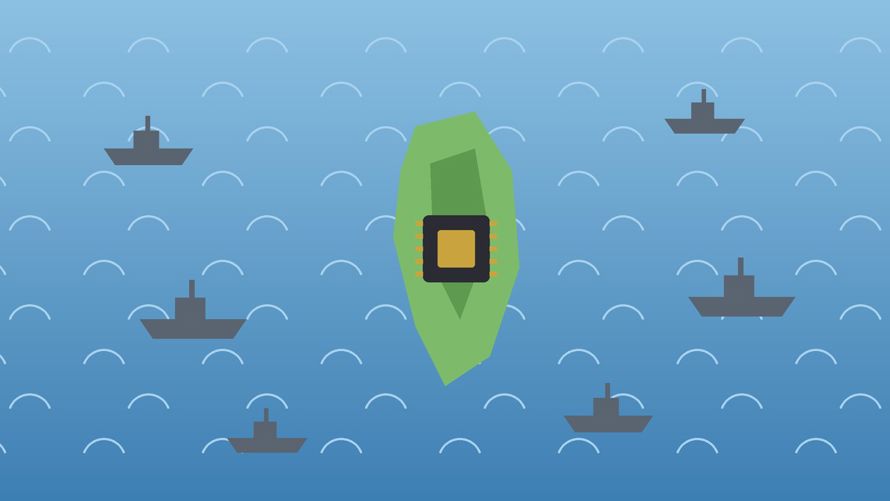
Taiwan Is a Small Island at the Centre of a Big Power Struggle
If you look at Taiwan on a map, it is easy to miss. It is an island of about 23 million people, roughly 180 kilometres off China’s coast, a little smaller in area than Kerala. And yet, when defence experts list the places where a war between great powers could start, Taiwan is almost always first.
How did such a small place become so important? I think it comes down to three stories that overlap.
Story One: A History Never Settled
In 1949, after losing China’s civil war to the Communists, the Nationalist government of the Republic of China retreated to Taiwan. For decades, both governments claimed to be the real China. In 1971, the UN seat passed to Beijing, and most countries, including later the United States, switched diplomatic recognition.
But the question of Taiwan’s status was never resolved. Beijing says Taiwan is part of China and must be “reunified,” by force if necessary. Taiwan’s government runs its own military, currency, passports and elections. The world mostly pretends this awkward situation can last forever.
Story Two: A Democracy That Works
Taiwan was under martial law until 1987. Since then, it has become one of Asia’s most vibrant democracies, with peaceful transfers of power between parties, a free press and strong civil rights. Surveys show that very few people in Taiwan want to be ruled by Beijing. Most prefer the status quo, and a growing number see themselves as Taiwanese first.
That makes Taiwan a powerful symbol. For China’s leaders, a successful Chinese-speaking democracy next door is uncomfortable. For democracies, abandoning Taiwan would feel like abandoning a principle.
Story Three: The Chips Everyone Needs
This is the part many people overlook. Taiwan’s TSMC makes the vast majority of the world’s most advanced semiconductor chips, the ones inside smartphones, data centres, AI systems, cars and weapons. If Taiwan’s factories stopped, the global economy would face a shock bigger than COVID.
People sometimes call this Taiwan’s “silicon shield”: the idea that the world cannot afford a war there. I am not sure that shield is as strong as people hope. It may deter attack, but it also makes control of Taiwan more valuable.
Rising Pressure
In recent years, China has sent warplanes and ships around Taiwan almost daily and held large military drills that look like rehearsals for a blockade. It also uses economic pressure, cyber attacks and outreach to opposition politicians.
The United States does not formally recognise Taiwan but sells it weapons and keeps a policy of “strategic ambiguity” about whether it would defend the island. Japan, whose southern islands are very close, has also become more vocal about the risk, which has angered Beijing.
Why India Should Care
- Supply chains: India’s growing electronics industry depends on chips, many of them made in Taiwan.
- Investment: Taiwanese companies such as Foxconn are building big factories in India.
- Security: A war in the Taiwan Strait would disrupt Indo-Pacific shipping lanes and could change the balance of power on our own border with China.
India has no official diplomatic ties with Taiwan, but trade, education and technology links have grown quietly. I think that careful, practical approach is the right one.
Will There Be War?
I don’t think a war is inevitable. An invasion across the sea would be enormously risky for China, and a long blockade would hurt China’s own economy. But accidents, miscalculations and nationalism can push leaders into choices nobody planned.
The Other View
Many in China see Taiwan as unfinished business from a civil war and a lingering wound from the era of foreign interference, and they see American arms sales as provocation. Some Western analysts also argue that pushing too hard on Taiwan’s status increases the risk of war. These views deserve attention. But I believe the 23 million people of Taiwan should have the biggest say in their own future, and the world should work hard to keep that question peaceful.

I am the Head of Anaesthesiology at Jessa Hospital, Hasselt. I graduated from Vrije Universiteit Brussel with a master's degree in Medicine and completed a Master of Specialist Medicine in Anaesthesiology at the same university. After my training at UZ Brussel I have worked for 15 years in this role. My areas of interest are anaesthesia, pain medicine and intensive care.