Tower Move: three discs, three pegs, and a puzzle that teaches patience
There's a famous puzzle, often called the Tower of Hanoi, that looks almost too simple. A stack of discs sits on one peg, biggest at the bottom. Move the whole stack to another peg, one disc at a time, and never put a bigger disc on top of a smaller one. That's all. And yet it has fascinated mathematicians for over a century.
Tower Move in Think & Remember brings it to children, with bright discs and clear rules.
How it works
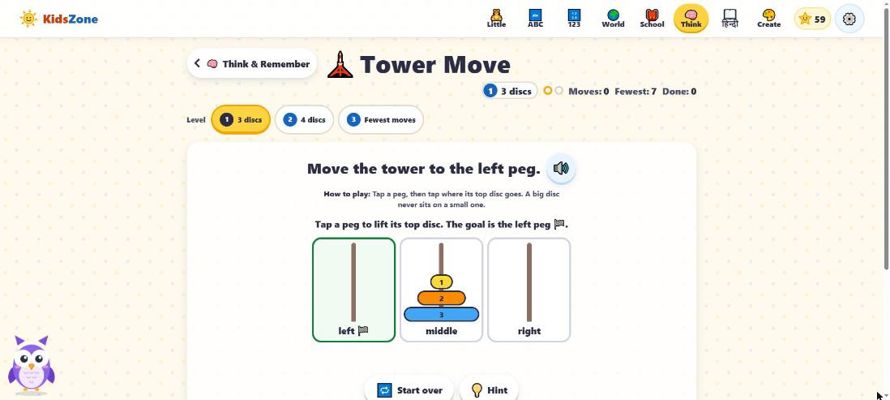
In the screenshot, three pegs stand side by side: left, middle and right. Three discs, numbered 1, 2 and 3, are stacked on the middle peg. The goal is the left peg, marked with a flag. The instruction says: "Tap a peg to lift its top disc." Then tap where it goes. A big disc never sits on a small one.
At the top, counters show Moves, Fewest (7 for three discs) and how many towers are done.
Three levels
- 3 discs: the classic beginner puzzle, solvable in 7 moves
- 4 discs: much harder, with a best solution of 15 moves
- Fewest moves: the challenge is not just to finish, but to finish in the smallest number of moves
That Fewest counter is the secret teacher. Finishing in 15 moves when 7 is possible tells your child there's a better way. Finding it takes thinking, not luck.
Why it's good for children
Tower Move builds:
- Planning: you have to think a few moves ahead
- Patience: rushing usually means getting stuck
- Rule-following: the "no big on small" rule never bends
- Breaking problems down: to move 3 discs, you first move 2 out of the way
That last idea is powerful. Big problems become manageable when you split them into smaller ones, a lesson that applies far beyond puzzles.
A hint for parents (don't share it too soon)
With three discs, the smallest disc moves on every other turn, always in the same direction round the pegs. Let your child discover patterns like this themselves. If they're stuck after several tries, ask: "Where does the smallest disc go first?"
Build a real one
Stack three coins or three bangles of different sizes on a plate, and use three plates as pegs. Physical pieces make the puzzle easier to think about, and children love solving the "real" version after the screen one.
When to stop
This is a puzzle that can frustrate. If your child is getting upset, stop and come back tomorrow. Many children solve it the next day without trying, because their brain kept working on it overnight. That's a nice thing to point out: sometimes rest is part of solving.
For more planning puzzles, try Maze Run and Hoot's Path.

MindStick Software Pvt. Ltd. is a Microsoft Gold Partner in software application development. Our expertise is in software product design, custom programming, database design, web design and programming and cutting edge mobile applications development.