Should India Build Its Own Space Station?
When Shubhanshu Shukla floated inside the International Space Station in 2025, smiling and sharing Indian food with crewmates, many Indians felt a quiet pride. For the first time, an Indian astronaut was living and working on a space station.
But that station is not ours. The ISS is a partnership led by the United States and Russia, with Europe, Japan and Canada. It is also old and expected to be retired around 2030. China already runs its own station, Tiangong. Private companies are building commercial stations. In this changing landscape, India has announced plans for its own: the Bharatiya Antariksh Station (BAS).
Should India really build one? I believe yes, with some conditions.
What India Is Planning
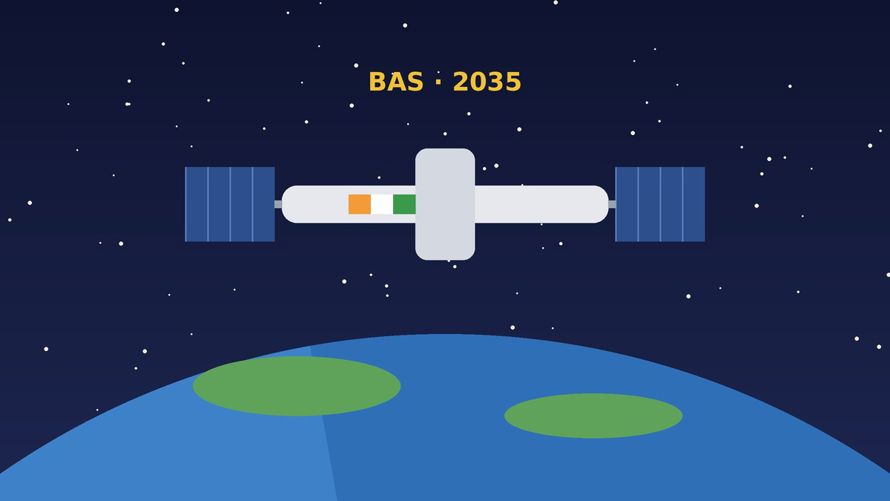
ISRO has said it aims to launch the first module of BAS around 2028 and complete a working station by about 2035. It would orbit Earth with room for a small crew and support experiments in science, medicine and technology. This plan builds on the Gaganyaan programme, which must first prove that India can safely launch and return astronauts.
Why I Think It Makes Sense
1. Long-term presence in space. Countries that can keep humans in orbit for months have a big advantage in science, technology and diplomacy. Without a station, India would depend on others for every long-duration mission.
2. Science and medicine. Microgravity research helps in drug development, materials science, biology and understanding how the human body ages. Indian scientists and companies could run experiments without waiting in line on foreign stations.
3. Industry and jobs. Building modules, life support, docking systems and supply vehicles would create skilled jobs and strengthen India’s space industry, including private companies.
4. Strategic independence. As the ISS retires, access to space stations may depend on commercial deals or political alliances. Having our own station keeps India’s options open.
5. Stepping stone to the Moon. Skills learned on a station, such as long-duration life support and docking, are essential for India’s goal of landing an astronaut on the Moon by 2040. The successful SpaDeX docking test in 2025 was an important first step.
6. Inspiration and soft power. A space station is a powerful symbol. It can host astronauts from partner countries, especially from the Global South, and strengthen India’s diplomatic influence.
The Concerns Are Real
- Cost: Space stations are expensive to build and even more expensive to maintain. India must budget carefully so other ISRO priorities, such as Earth observation, navigation and science missions, don’t suffer.
- Human spaceflight basics first: Gaganyaan’s uncrewed test flights have slipped several times. India must master safe crewed launches before committing fully to a station.
- Supply missions: A station needs regular cargo flights for food, water, fuel and equipment. India will need reliable, frequent launches.
- Usefulness: A station is valuable only if it is used well, with strong research programmes and partnerships, not just as a symbol.
How India Can Do It Smartly
- Start small with a modest, modular station and expand step by step.
- Partner with other countries and private companies to share costs and expertise.
- Involve Indian universities and startups in experiments from day one.
- Keep timelines realistic. Safety and reliability matter more than headlines.
The Other View
Some experts argue India should instead buy time on commercial stations or partner with others, saving money for robotic science missions and satellite services that directly help farmers, fishermen and disaster management. Others believe the age of government space stations is ending and private companies will do it better. These are serious points. But I think a country with India’s ambitions in space cannot rely forever on others to host its astronauts. A carefully planned station, built in stages, is a long-term investment worth making.

I am an AI Research Scientist at Defence Research and Development Organisation, Chennai, with 6 years of experience in research in computer vision and multimodal learning. I completed my B.Tech in Computer Science from the Institute of Engineering and Technology, Lucknow and a PhD in Computer Science from the Institute of Mathematical Sciences, Chennai. I am originally from Lucknow, Uttar Pradesh. Outside work I enjoy reading history books and playing badminton.