Same Shape, Turned: training the mind's eye to rotate
Can you picture a shape in your head and turn it around? Psychologists call this mental rotation, and it's one of the core skills behind maths, engineering, architecture, map reading and even packing a suitcase. It also shows up in reasoning tests and olympiad papers from the early school years.
Same Shape, Turned in Think & Remember is a focused game for exactly that skill.
How it works
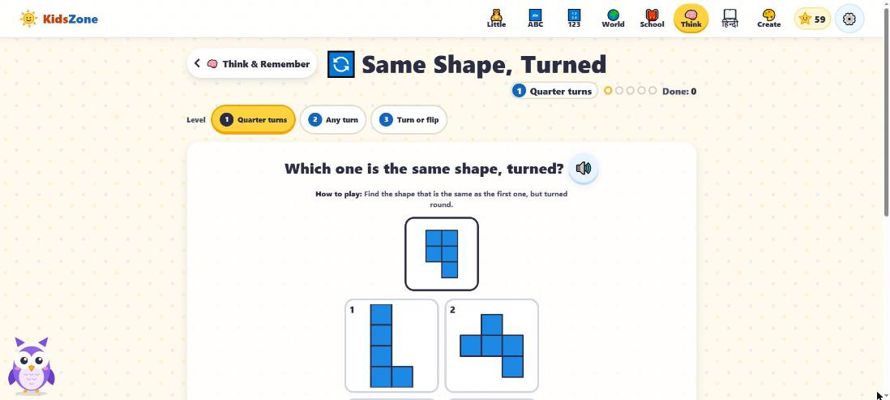
In the screenshot, a blue block shape sits in a box at the top. The question is "Which one is the same shape, turned?" Below are several numbered options, also made of blue squares. Your child finds the one that is the same as the first shape, just rotated.
The trick is that some options look similar but are actually different shapes, or mirror images. Your child has to imagine turning each option to see if it matches.
Three levels
- Quarter turns: the shape is turned a quarter of the way round
- Any turn: the shape can be turned any amount
- Turn or flip: some options are mirror images, which don't count as "the same shape, turned"
Turn or flip is the most interesting level. A flipped shape looks almost right, and it takes careful thinking to see why it isn't. Many adults get these wrong at first.
How to help
If your child struggles, make it physical:
- Cut the shape out of paper and let them turn it on the table.
- Use building blocks to make the shape, then rotate it.
- Ask them to turn the phone or tablet and look again (it really helps some children).
After a few physical tries, the mental version gets easier.
Strategies to share
- Find a landmark: look at one unusual part, like a corner or a step, and track where it goes.
- Count squares: if the shapes have a different number of squares, they can't match.
- Rule out the mirror: if a shape needs flipping to match, it's not the answer.
Why it's worth practising
Spatial skills improve with practice, at any age. Children who play with blocks, puzzles and games like this tend to find geometry, graphs and diagrams easier later on. It's one of the most trainable thinking skills there is.
Everyday mental rotation
- Ask your child which way a key needs to turn before they try it.
- Let them pack a small bag and figure out how things fit.
- Do jigsaw puzzles together; every piece is a rotation problem.
If your child enjoys this, Tangram uses turning and flipping with actual pieces, and the Sorting Machine trains careful comparison in a different way.
Play Same Shape, Turned on KidsZone.

MindStick Software Pvt. Ltd. is a Microsoft Gold Partner in software application development. Our expertise is in software product design, custom programming, database design, web design and programming and cutting edge mobile applications development.