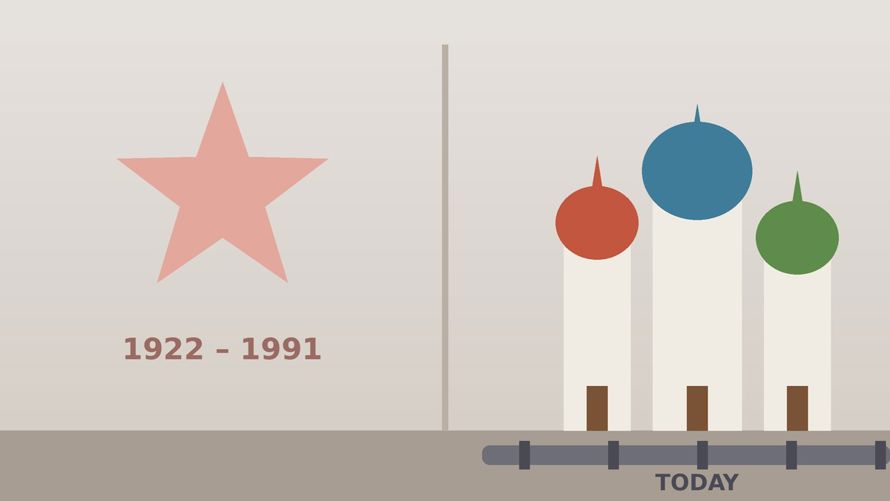
Why Today’s Russia Is Nothing Like the Soviet Union
Western headlines often describe Russia’s actions as “Soviet-style.” In India too, many people still think of Russia as the old Soviet friend, the country of cheap books, MiG fighters and Raj Kapoor’s fans. Both images are understandable. Both miss how much has changed.
Having read a fair amount about the Soviet years and watched Russia over the last two decades, I have come to a clear view: Russia today rhymes with the Soviet Union, but it is not the Soviet Union.
No Big Ideology
The Soviet Union was built on an idea. Communism claimed to offer a better future for workers everywhere. It inspired parties, revolutions and intellectuals on every continent. Moscow was not just a capital. It was the headquarters of a global movement.
Russia today has no such universal message. Its leaders talk about sovereignty, tradition, the Orthodox Church, family values and Russia as a great civilisation. Those ideas appeal to some people abroad, but they are about Russia, not about saving the world. Nobody is starting a revolution in Russia’s name.
A Market Economy With a Strong State
In the Soviet Union, the state owned almost everything. There were no billionaires, no private companies of any size and no stock market.
Russia today has billionaires, private banks, supermarkets full of goods and a currency traded worldwide. The state is very powerful, especially in energy and defence, and wealthy businesspeople depend on staying close to power. But it is a form of state-guided capitalism, not communism.
The economy also depends heavily on oil, gas, metals and grain. The Soviet Union, for all its failures, built factories for almost everything. Russia today exports raw materials and imports many advanced goods, now increasingly from China.
Smaller and Less Central
- The USSR had about 290 million people across 15 republics. Russia has around 145 million.
- Ukraine, the Baltic states, Kazakhstan and others are now independent, and many lean toward Europe, China or their own path.
- In the Cold War, the world was split between Washington and Moscow. Today, China is the main rival to the United States, and Russia’s economy is smaller than India’s.
Where the Similarities Are Real
I don’t want to swing too far the other way. Some things feel familiar.
- Power is concentrated in a small group around the president, with little real opposition.
- Security services play a central role, just as the KGB did.
- Media and dissent are tightly controlled, especially since the war in Ukraine began in 2022.
- The desire to be a great power and to control neighbours remains strong.
The war in Ukraine has made these similarities sharper. Sanctions, censorship and a militarised economy have pushed Russia toward a more closed system than at any time since 1991.
Why the Difference Matters
If we treat Russia as the old USSR, we expect the wrong things. The Soviet Union wanted to spread a system. Russia mostly wants security, respect and a sphere of influence around its borders. That makes it unpredictable in some ways but also limited. It does not have the ideological pull or economic weight to lead a global bloc on its own.
For India, this understanding matters too. Our friendship with Moscow was built in Soviet times, but the Russia we deal with today is a different partner: an energy and defence supplier, increasingly close to China, and isolated from the West.
The Other View
Some historians argue that the difference is mostly on the surface, that Russia’s rulers think in the same imperial way as the czars and the Soviet leaders before them, and that ideology was always a cover for power. Others say Russia is drifting back toward Soviet habits so fast that the comparison is becoming fair again. I accept parts of both views. But I still believe that to understand Russia today, we have to look at the country as it is, not as the one that collapsed in 1991.

Working as Head of Corporate Credit with BBVA Mexico in Guadalajara. I have 8 years of experience in corporate credit and risk, and earlier worked with Banorte as Credit Analyst. I graduated from the University of Guadalajara with a degree in Economics and completed a master's degree in Finance at ITESO. In my free time I like cooking Mexican food and travelling around Mexico.