Ari has 16 strawberries: Story Sums and the art of reading a maths question
Ask any primary school teacher where children lose the most marks in maths, and many will say word problems. Not because the sums are hard, but because the child has to read a few sentences, work out what's being asked, and then choose the right operation. That's three skills at once.
Story Sums in School Skills practises all three, with small stories and friendly pictures.
How it works
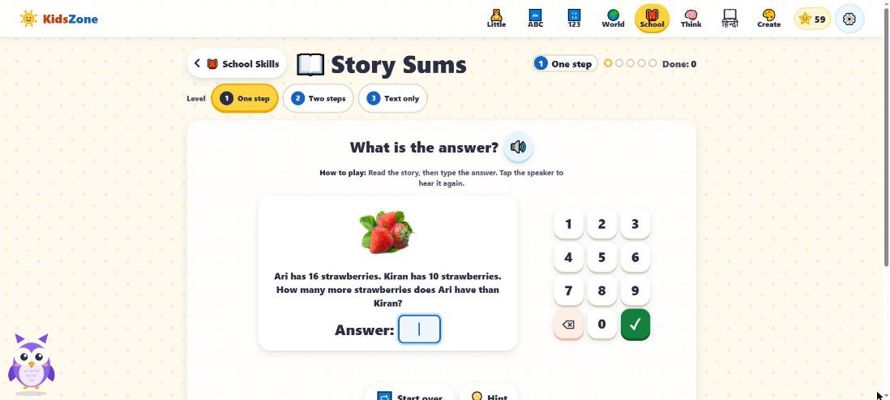
The screenshot shows a bunch of strawberries and a short story: "Ari has 16 strawberries. Kiran has 10 strawberries. How many more strawberries does Ari have than Kiran?" Your child reads it (or taps the speaker to hear it again), types the answer in the box using the number pad, and taps the tick.
That example is a good one, because "how many more" questions confuse many children. The word "more" makes them want to add, but the answer needs subtraction.
Three levels
- One step: a single calculation
- Two steps: two calculations in a row
- Text only: no picture, just the words
"Text only" is the level that looks most like a school exam. Removing the picture makes children rely on reading carefully, which is exactly the skill tests are checking.
A four-step method for every story
Give your child a simple routine:
- Read the whole story once, slowly.
- Find the question. What are they actually asking?
- Choose: add, take away, times or share?
- Check: does the answer make sense in the story?
The last step catches a lot of mistakes. If Ari has 16 and Kiran has 10, Ari can't have 26 more.
Key words help, but carefully
Words like "altogether" usually mean add, "left" usually means take away, "each" often means times or share. These are useful hints, but teach your child that they're clues, not rules. "How many more" is the classic trap.
Make up stories together
The best practice is when your child writes the story. "Make up a sum about mangoes for me to solve." Children love setting problems for grown-ups, and writing a story sum shows they understand how one works. Use names of family members and real things from your home. It's more fun and more memorable.
For readers and non-readers
For children still learning to read, the speaker button makes Story Sums accessible. For confident readers, try turning off read-aloud in Settings so they practise reading the question themselves.
If your child finds stories easy but struggles with sums that hide the missing number, try Missing Number Sums alongside this game.

MindStick Software Pvt. Ltd. is a Microsoft Gold Partner in software application development. Our expertise is in software product design, custom programming, database design, web design and programming and cutting edge mobile applications development.