Odd or Even: sorting numbers into two baskets, all the way to 1000
Odd and even is one of those maths ideas that seems tiny but turns up everywhere: in times tables, in sharing things equally, in house numbers on a street, even in deciding who goes first in a game. Children who get it early have a handy tool for life.
Odd or Even in School Skills makes it a sorting game.
How it works
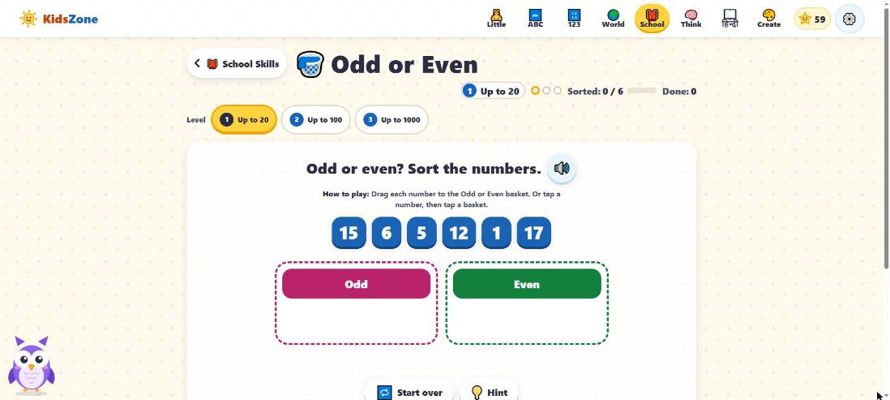
The screenshot shows six numbers in blue tiles: 15, 6, 5, 12, 1 and 17. Below are two baskets, pink for Odd and green for Even. Your child drags each number into a basket, or taps a number and then a basket. A counter shows how many have been sorted.
Three levels
- Up to 20
- Up to 100
- Up to 1000
The jump to 1000 is interesting. A child might be unsure about 347 at first, then realise they only need to look at the last digit, 7. That's a real "aha" moment: big numbers follow the same rule as small ones.
What odd and even really mean
Before the rule ("even numbers end in 0, 2, 4, 6 or 8"), give your child the meaning:
- An even number can be shared equally between two people with nothing left over.
- An odd number always leaves one extra.
Try it with sweets or biscuits. Six biscuits, two children: three each, nothing left. Seven biscuits: three each, and one left over. The leftover biscuit is what makes seven odd.
Patterns to notice
- Odd and even take turns: 1 odd, 2 even, 3 odd, 4 even.
- Even + even is always even.
- Odd + odd is always even (surprising to most children).
- Odd + even is always odd.
Let your child test these with small numbers. Discovering a rule that always works is exciting.
In everyday life
- House numbers: in many streets, one side has odd numbers and the other even. Check yours on a walk.
- Pairs: socks, shoes and chappals come in twos, so a full set is always even.
- Teams: can the class split into two equal teams? Only if the number is even.
Why it matters later
Odd and even comes back in multiplication tables (the 2 times table is all even), in division and in many reasoning puzzles. It's a small foundation that supports a lot.
If your child enjoys sorting numbers, the Sorting Machine in Think & Remember sorts shapes by rules, including secret ones your child has to work out.

MindStick Software Pvt. Ltd. is a Microsoft Gold Partner in software application development. Our expertise is in software product design, custom programming, database design, web design and programming and cutting edge mobile applications development.