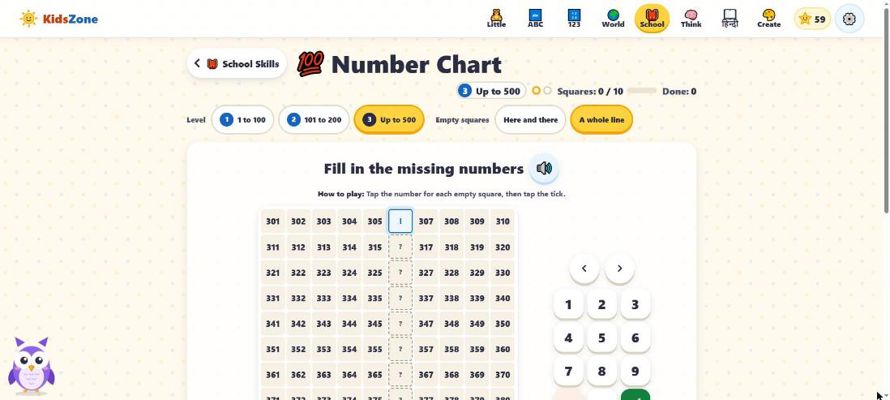
Fill in the missing numbers: the Number Chart from 1 to 500
The hundred chart, a 10 by 10 grid of numbers, is one of the most useful tools in early maths. It looks simple, but it hides all sorts of patterns, and children who know it well find addition, subtraction and place value much easier.
The Number Chart in School Skills turns the chart into a fill-the-gaps game, and takes it all the way to 500.
How it works
In the screenshot, the chart shows 301 to 380 with a whole column missing: 306, 316, 326, 336 and so on are replaced by question marks. Your child taps the number for each empty square on the number pad, then the tick. Arrows let them move between gaps. A counter shows how many squares are filled.
Three ranges and two styles
The levels set the range:
- 1 to 100
- 101 to 200
- Up to 500
And a second set of buttons decides how the gaps appear:
- Here and there: scattered gaps across the chart
- A whole line: an entire row or column is missing
"A whole line" is the clever one. When a whole column is missing, a child can't just count on from the square before. They have to notice the pattern going down: 306, 316, 326. That's the key insight of the hundred chart: moving down a row adds ten.
Patterns to look for
Once your child is comfortable, ask them to spot patterns:
- Moving right adds 1.
- Moving down adds 10.
- Moving diagonally down and right adds 11.
- Every number in a column ends with the same digit.
Children who discover these themselves remember them far better than children who are told.
Bigger numbers, same rules
The ranges above 100 are a great confidence builder. A child who's nervous about "big numbers" like 347 sees that the chart from 301 to 400 works exactly like the chart from 1 to 100. Only the hundreds digit has changed. That's place value, shown rather than explained.
Print a worksheet
Under the game, Print a worksheet makes an A4 page of 20 new questions at the chosen level, with an optional answer page. A printed chart with gaps is a classic Class 1 homework, so this is handy before tests.
Make a giant chart
On a rainy afternoon, draw a big 10 by 10 grid on chart paper and let your child fill it from 1 to 100 with coloured pens. Then colour all the numbers ending in 5, or all the even numbers. The patterns that appear are beautiful, and your child will want to put it on the wall.
For a different way of seeing numbers in order, try Number Line Jump in Think & Remember.
Play Number Chart on KidsZone.

MindStick Software Pvt. Ltd. is a Microsoft Gold Partner in software application development. Our expertise is in software product design, custom programming, database design, web design and programming and cutting edge mobile applications development.