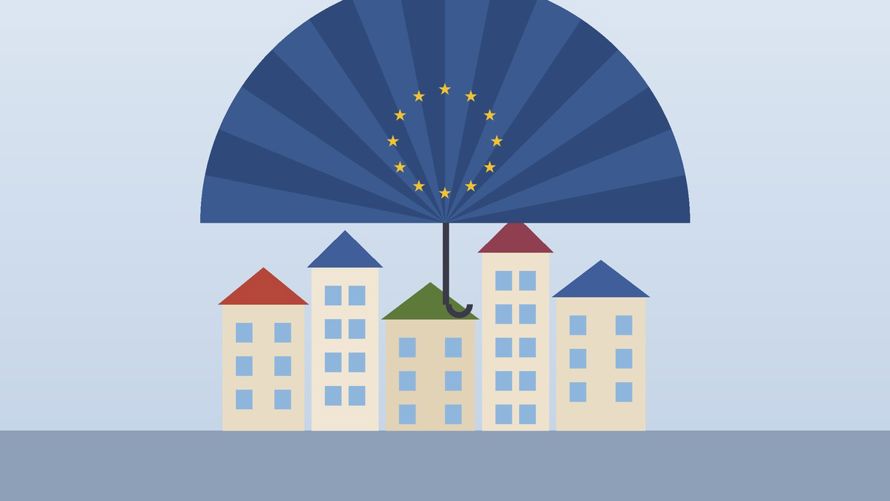
Why Europe Still Depends on America for Its Security
The European Union’s economy is roughly as large as America’s. Its population is bigger. Countries like Germany, France, Italy and Sweden build world-class planes, ships, submarines and tanks. On paper, Europe should be able to defend itself without help.
And yet, for nearly 80 years, the real guarantee of European security has been the United States. When Russia launched its full-scale invasion of Ukraine in 2022, the most important military aid, intelligence and leadership came from Washington. Why?
How It Began
After the Second World War, Western Europe was devastated, and the Soviet army sat in the middle of the continent. In 1949, the United States, Canada and Western European countries created NATO. Its core promise, Article 5, says an attack on one is an attack on all.
American troops stayed in Germany, Italy, Britain and elsewhere. American nuclear weapons became the final protection. The deal suited everyone. Europe could rebuild its economy and welfare states. America could keep the Soviet Union in check and lead the West.
The Comfort of Peace
When the Cold War ended in 1991, many European countries cut their armies sharply. Defence budgets fell. Conscription was dropped in many places. Money went to pensions, healthcare and infrastructure instead. I don’t blame them. After centuries of wars, Europeans finally had peace, and they enjoyed what people called a “peace dividend.”
But over time, the gap became huge. For years, many NATO members spent well under 2 percent of their GDP on defence. America spent far more and did much of the heavy lifting.
Where Europe Is Weakest
- Nuclear deterrence: Only France and Britain have nuclear weapons, and their arsenals are far smaller than America’s.
- Intelligence and satellites: Much of NATO’s surveillance and early warning depends on US systems.
- Logistics and air power: Airlifting troops, refuelling jets in flight and running large air campaigns all lean on American capabilities.
- Ammunition: The Ukraine war exposed how little ammunition many European countries could produce quickly.
- Fragmented industry: Europe has many different tanks, jets and systems, built by national companies. America buys in scale.
Why the Mood Changed
Two shocks changed Europe’s thinking. First, Russia’s invasion of Ukraine showed that large-scale war in Europe was not a thing of the past. Second, Washington made it clear that it expects Europe to pay much more, and American policy has become less predictable from one administration to the next.
At NATO’s 2025 summit in The Hague, members agreed to aim for 5 percent of GDP on defence and related security spending by 2035. Germany relaxed its strict borrowing rules to fund its armed forces. The EU launched big plans and loans to boost joint weapons production. Poland and the Baltic states, closest to Russia, are spending at levels not seen since the Cold War.
Can Europe Stand on Its Own?
I think it can, but not quickly. Building factories, training soldiers and developing new systems take a decade or more. And Europe still has to agree on who leads, who pays and whether France’s nuclear umbrella can protect others. Different countries also see different threats: Poland worries about Russia, Italy and Spain worry more about the Mediterranean.
Why It Matters to India
A stronger, more independent Europe could be a valuable partner for India in defence technology, manufacturing and trade, as the India-EU trade agreement shows. Europe is also learning what India has long known: strategic autonomy is safer than relying on one powerful friend.
The Other View
Some argue that Europe’s dependence is not a weakness but a smart division of labour that has kept the peace for decades, and that building separate European defence would duplicate NATO and waste money. Others say America benefits enormously from its influence in Europe and should not complain about the cost. I see merit in both. But a continent this rich and this capable should be able to protect itself first. I believe Europe has finally started to accept that.

I am an Audit Manager at KPMG, Guadalajara, with 13 years of experience in external audit and tax compliance. I graduated from Tecnologico de Monterrey with a degree in Public Accounting. Outside work I enjoy visiting Pueblos Magicos and hiking.