Is the US Losing Its Place as the World’s Only Superpower?
In the 1990s, the United States was so powerful that a French minister invented a new word for it: a “hyperpower.” It had the strongest military, the biggest economy, the most influential culture and allies all over the world. No country could challenge it.
Thirty-five years later, I often hear the opposite claim: that America is in decline and its time is over. I think both views go too far. Here is how I see the balance.
Where America Is Still Unmatched
- Military reach: The US spends more on defence than the next several countries combined and has bases, aircraft carriers and alliances across the globe. No other country can project force so widely.
- The dollar: Most global trade, debt and reserves are still in dollars. That lets America borrow cheaply and use sanctions as a powerful weapon.
- Technology and innovation: The leading AI companies, chip designers, cloud providers and biotech firms are mostly American. Its universities still attract the world’s best students.
- Energy: The US is now one of the world’s largest oil and gas producers, which gives it a cushion that Europe and China lack.
- Demographics: Thanks to immigration, America’s population is younger and growing faster than that of China, Japan or most of Europe.
Where Its Position Has Weakened
- China’s rise: China’s economy is close to America’s in size by some measures and larger by others. It leads in manufacturing, shipbuilding, EVs, batteries and solar. Its navy is now the largest in the world by number of ships.
- Allies’ doubts: Tariffs on friends, pressure on NATO allies and sudden policy changes have made many partners unsure whether Washington will stand by them. Europe now talks openly about “strategic autonomy.”
- Costly wars: Iraq and Afghanistan drained money and trust. The 2026 war with Iran, and the shock to oil markets after the Strait of Hormuz was closed, showed both America’s military power and the limits of what that power can settle.
- Division at home: Deep political polarisation makes long-term planning difficult. A superpower that is constantly fighting itself is harder for others to rely on.
- Others are hedging: Countries like India, Brazil, Saudi Arabia, Turkey and Indonesia increasingly pick partners issue by issue rather than lining up behind one power.
A Multipolar World
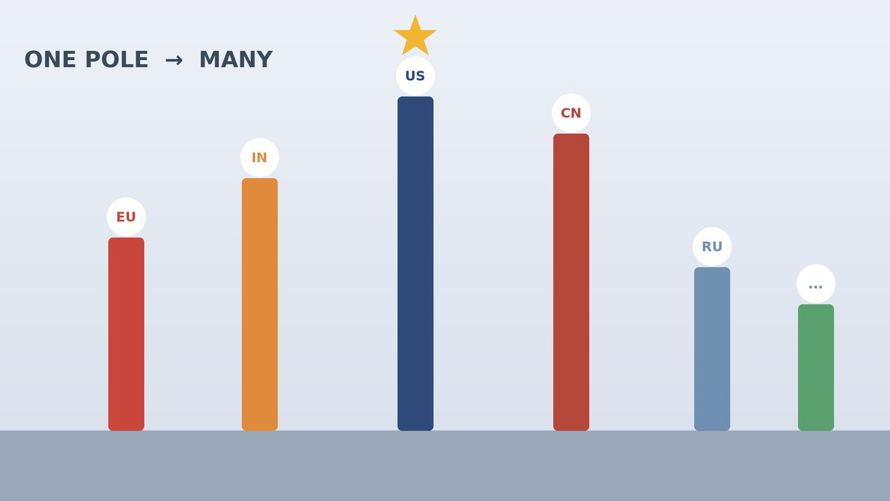
I think the most accurate description of 2026 is not “American decline” but “a multipolar world.” America is still first, but it is no longer alone. China is a serious second. Regional powers have more room to manoeuvre. Groups like BRICS, which India hosted in 2026, reflect that shift, even if they are not unified enough to replace Western institutions.
What It Means for India
For India, this moment is both an opportunity and a test. We have deep ties with the US in technology, defence and diaspora, along with a new trade deal, but we also saw how quickly tariffs can strain relations. We trade heavily with China while facing it on the border. We buy energy from Russia and the Gulf. India’s strategy of strategic autonomy, working with everyone without becoming anyone’s camp follower, fits a multipolar world well.
The Other View
Some argue that predictions of American decline have been made for decades, after Vietnam, after Japan’s rise in the 1980s and after 2008, and every time the US bounced back. Others believe the decline is real and faster than Washington admits, especially as China pulls ahead in key industries. I lean toward the first view on military and technology, and toward the second on trust and leadership. The US will stay a superpower for a long time. But the world will no longer simply follow its lead, and I think that change is permanent.

Working as Software Tester with Infosys. I have 10 years of experience in manual testing of web and mobile applications, and earlier worked with HCLTech as Software Tester. I did my B.Tech in Information Technology from Punjab Engineering College, Chandigarh. In my free time I like watching football and trekking.