Who Lives Where: taking each animal home, and then asking why
"Where does a tiger live?" A child might say "in the zoo" or "in the jungle". Both are reasonable answers, and both are a starting point for one of the most important ideas in early science: animals live where their bodies and needs fit.
Who Lives Where in Our World is a sorting game about animal homes, and its last level asks the question that matters most: why?
How it works
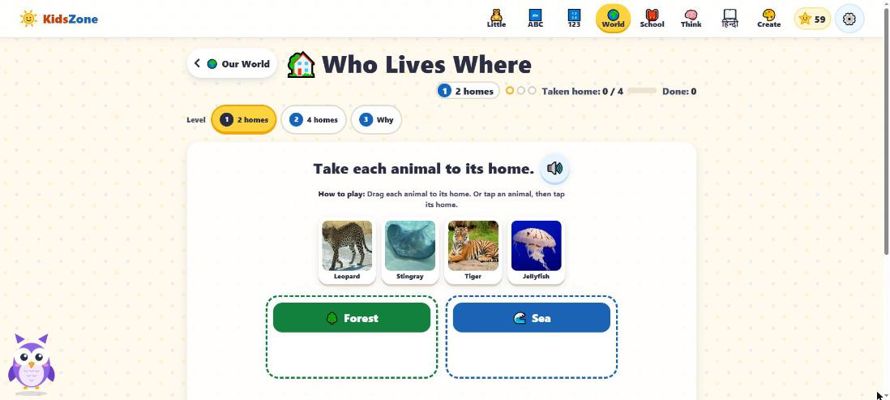
In the screenshot, four animals wait at the top: a leopard, a stingray, a tiger and a jellyfish. Below are two homes: Forest and Sea. Your child drags each animal to its home, or taps the animal and then the home. A counter shows how many have been taken home.
Three levels
- 2 homes: two choices, like forest and sea
- 4 homes: more homes to choose from
- Why: the reason behind the home
The Why level is what sets this game apart. Matching a fish to water is easy. Understanding that a fish has gills to breathe underwater, or that a camel's humps help it survive in the desert, is real understanding.
Habitats in Indian textbooks
Animal homes appear in EVS from Class 1 onwards: forest, desert, water, polar regions, mountains, grasslands. India has nearly all of them. Use that:
- Desert: camels in Rajasthan
- Mountains: yaks and snow leopards in the Himalayas
- Forest: tigers and elephants in national parks
- Sea: dolphins and fish along the coasts
- Rivers: the gharial in the Chambal
It turns a textbook chapter into a map of the country your child lives in.
Ask "what if?"
Once your child knows where an animal lives, ask what would happen if it moved:
- What if a polar bear lived in Rajasthan?
- What if a fish lived in a tree?
- What if a camel lived in the sea?
Children find these funny, and in explaining why it wouldn't work, they're explaining adaptation.
Home for us too
End with your own home. Why do we live in houses? What do we need: shelter, water, food, warmth? It helps children see that people have habitats too, and that every living thing needs the right place to live.
Before and after
Browsing the Animals, Sea Animals and Birds pages first gives your child the names they need. Afterwards, Living or Non-living is a good companion sorting game.
Play Who Lives Where on KidsZone.

MindStick Software Pvt. Ltd. is a Microsoft Gold Partner in software application development. Our expertise is in software product design, custom programming, database design, web design and programming and cutting edge mobile applications development.