Is a river alive? Living or Non-living and the questions children love to argue about
"Living and non-living things" is one of the first chapters in almost every EVS textbook. It sounds simple. Then a child asks whether a river is alive because it moves, or whether a seed is alive because it doesn't, and suddenly it's a real science discussion.
Living or Non-living in Our World is a sorting game that invites exactly those conversations.
How it works
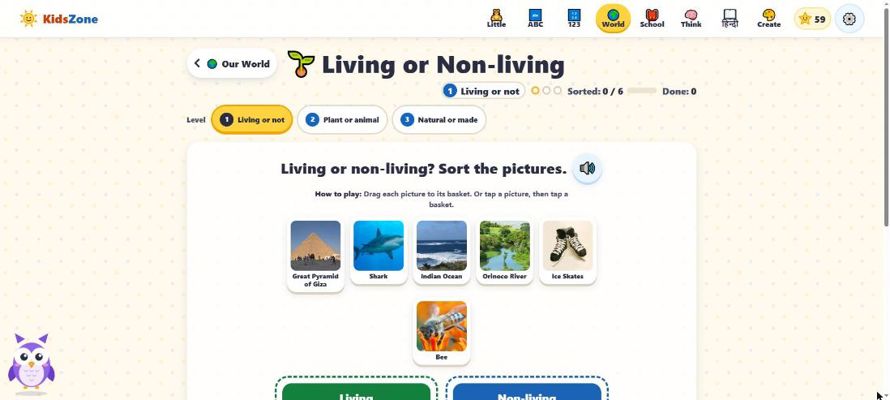
The screenshot shows six pictures: the Great Pyramid of Giza, a shark, the Indian Ocean, the Orinoco River, a pair of ice skates and a bee. Below them are two baskets, Living and Non-living. Your child drags each picture into its basket, or taps a picture and then taps a basket. A counter at the top shows how many have been sorted.
I love the mix in that screenshot. A pyramid, an ocean and a river are big and impressive, but none of them is alive. A bee is tiny, but it is. That's the heart of the lesson: being alive is not about size or movement.
Three levels
- Living or not: the classic sort
- Plant or animal: both are living, but which kind?
- Natural or made: things from nature versus things people made
The third level adds a new idea. A river is non-living and natural. Ice skates are non-living and made by people. Children start to see that one thing can belong to more than one group.
How do we know something is alive?
Give your child a simple checklist to use in the game and at home:
- Does it grow?
- Does it need food and water?
- Does it breathe?
- Can it have babies or make new plants?
A river moves, but it doesn't grow or eat or have babies. A plant doesn't walk, but it grows and needs water. The checklist settles most arguments.
The tricky ones
Some things are genuinely confusing, and it's fine to talk about them:
- Seeds: alive, but resting.
- Fire: it moves and grows, but it isn't alive.
- A cut flower: it was alive and is slowly dying.
- Wood: it came from a living tree.
These are great dinner-table questions. Let your child argue their case.
Sorting at home
Take ten objects from around the house and a few things from the garden: a stone, a leaf, a spoon, a flower, a toy. Make two piles, living and non-living. Then do it again as natural and made. Same objects, different groups.
What comes next
Once your child can sort living things, Who Lives Where asks where they live, and the Sorting Machine in Think & Remember turns sorting into a logic puzzle.
Play Living or Non-living on KidsZone.

MindStick Software Pvt. Ltd. is a Microsoft Gold Partner in software application development. Our expertise is in software product design, custom programming, database design, web design and programming and cutting edge mobile applications development.