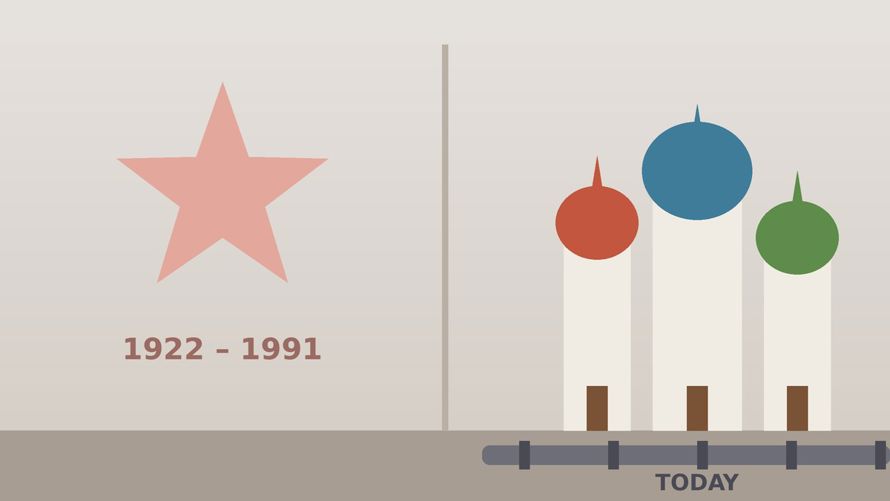
Why the Soviet Union Collapsed and What Russia Learned From It
It still amazes me that the Soviet Union ended without a world war. On 25 December 1991, Mikhail Gorbachev resigned as president, and the red flag was lowered over the Kremlin. Fifteen countries emerged where one had stood. No foreign army invaded. The system collapsed largely on its own.
Why did that happen, and why does it still matter so much to Russia today?
1. An Economy That Stopped Working
The Soviet planned economy was good at building steel mills, tanks and rockets. It was bad at producing what ordinary people wanted. By the 1970s and 1980s, shops had long queues and empty shelves. Technology lagged behind the West. Agriculture was so weak that the country imported grain. People called this period the “era of stagnation.”
2. Falling Oil Prices
The Soviet economy relied heavily on oil and gas exports to pay for imports. When global oil prices crashed in the mid-1980s, the country lost a key source of hard currency. Budgets and food supplies came under pressure.
3. The War in Afghanistan
The decade-long war from 1979 to 1989 cost lives, money and morale. Soldiers came home disillusioned. People began asking questions about a war they were told little about.
4. Gorbachev’s Reforms
When Gorbachev became leader in 1985, he wanted to save socialism, not end it. He introduced:
- Glasnost (openness): more freedom of speech and press.
- Perestroika (restructuring): economic reforms to make the system more efficient.
The reforms let people speak about past crimes, corruption and failures. But the economy did not improve fast enough. Openness without prosperity created anger instead of loyalty. The Chernobyl disaster in 1986, and the initial secrecy around it, further shook trust.
5. Nationalism in the Republics
The Soviet Union was officially a union of republics. Once people could speak more freely, nations like Lithuania, Latvia, Estonia, Georgia and Ukraine demanded independence. When Eastern European countries broke away from Soviet control in 1989, and the Berlin Wall fell, it became clear Moscow would not use full force to stop them.
6. The Failed Coup
In August 1991, hardliners tried to remove Gorbachev. The coup failed within days, partly because Boris Yeltsin stood on a tank in Moscow and rallied crowds. After that, power flowed quickly from the Soviet centre to the republics. By December, leaders of Russia, Ukraine and Belarus agreed to dissolve the Union.
What Russia Learned
This, to me, is the most important part. The lessons Russia’s leaders took from 1991 explain much of what Russia does today.
- Never loosen control too fast. Many in Moscow see glasnost as the mistake that opened the door to collapse. Today, media and political opposition are tightly controlled.
- A strong state comes first. The chaos of the 1990s, with economic collapse, crime and the rise of oligarchs, made many Russians value order over freedom.
- Don’t trust the West. Russian leaders believe the West took advantage of their weakness, especially as NATO expanded east. Vladimir Putin famously called the Soviet collapse “the greatest geopolitical catastrophe” of the century.
- Keep neighbours close. Moscow’s pressure on Ukraine, Georgia and others reflects a fear of losing influence in what it sees as its backyard.
- Keep the money flowing. Energy exports are again central to the budget, so the old dependence on oil and gas has not truly disappeared.
The Other View
Many people in the Baltic states, Ukraine and Central Asia see 1991 not as a catastrophe but as liberation, the moment their nations regained independence. Some historians argue the Soviet Union could have survived with different choices, while others believe it was doomed from the start. My own view is that it fell because it could no longer give its people either freedom or prosperity. Whether today’s Russia has truly learned that lesson is a question I keep asking.

Working as Project Manager with Aecon in Toronto. I have 11 years of experience in construction project management, and earlier worked with Ledcor as Project Coordinator. I graduated from Simon Fraser University with a BASc in Civil Engineering. I am originally from Vancouver, British Columbia. In my free time I like running and canoeing.