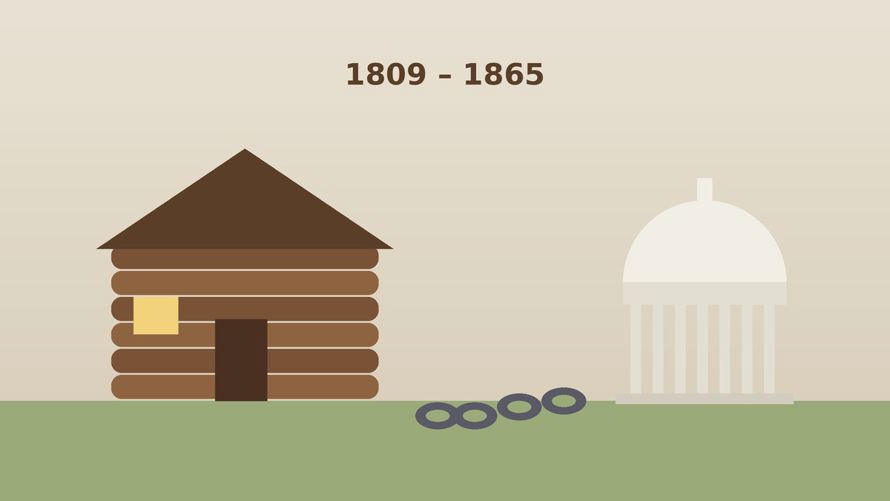
Abraham Lincoln, the Log Cabin Boy Who Held America Together
Every time I visit the United States, I notice how often Lincoln appears: on the penny, the five-dollar bill, monuments and school names. Americans disagree about many things, but most still see Lincoln as one of their greatest presidents. When I read his story, I understood why.
Born in a Log Cabin
Abraham Lincoln was born on 12 February 1809 in a one-room log cabin in Kentucky. His family were poor farmers who moved to Indiana and later Illinois. His mother died when he was nine. He did heavy farm work, split wood for fences and had very little formal schooling, perhaps a year in total.
But he loved books. He borrowed whatever he could find, read by firelight and taught himself grammar, mathematics and law.
Failures Before Success
Lincoln worked as a shopkeeper, postmaster, surveyor and boatman before becoming a lawyer. He entered politics in Illinois. His path was full of setbacks:
- A business partnership failed, leaving him in debt for years.
- He lost elections, including a famous Senate race in 1858 against Stephen Douglas.
- He struggled with periods of deep sadness throughout his life.
Yet his debates with Douglas on slavery made him nationally known. In 1860, he won the presidency.
A Nation Breaking Apart
Even before Lincoln took office, Southern states began to leave the Union because they feared he would restrict slavery. In April 1861, the Civil War began. It would last four years and kill around 620,000 soldiers, more than any other American war.
Lincoln’s first goal was to save the Union. Over time, he made ending slavery a central purpose of the war.
The Emancipation Proclamation
On 1 January 1863, Lincoln issued the Emancipation Proclamation, declaring enslaved people in Confederate-held areas free. It did not immediately free everyone, but it changed the meaning of the war and allowed Black soldiers to join the Union army, nearly 200,000 of whom eventually served.
Later, he pushed hard for the 13th Amendment, which abolished slavery throughout the United States.
The Gettysburg Address
In November 1863, at a cemetery for soldiers killed at Gettysburg, Lincoln gave a speech of only about 272 words. He described the war as a test of whether a nation built on liberty and equality could survive, and ended with the hope that “government of the people, by the people, for the people, shall not perish from the earth.” It remains one of the most famous speeches in history.
Victory and Tragedy
The Union won the war in April 1865. Just days later, on 14 April 1865, Lincoln was shot at Ford’s Theatre in Washington by John Wilkes Booth, a Confederate sympathiser. He died the next morning.
What Made Lincoln Great
- Humility: He appointed rivals to his cabinet, people who had competed against him, because he believed they were the best for the job.
- Patience: He moved carefully, sometimes frustrating abolitionists, but kept the country and army together.
- Moral clarity: He believed slavery was wrong and that the nation’s founding ideals had to include everyone.
- Words: He used simple, powerful language that ordinary people could understand.
His Complicated Legacy
Historians note that Lincoln’s views on race, like those of most white Americans of his time, were limited by modern standards. Early in his career, he supported ideas of sending freed slaves abroad. During the war, he suspended certain civil liberties, which critics saw as dangerous. These parts of his story should be acknowledged.
The Other View
Some argue that Lincoln’s fame comes partly from his assassination, which turned him into a martyr, and that Black activists, soldiers and abolitionists like Frederick Douglass deserve more credit for ending slavery. Others criticise his wartime limits on freedoms. These views add balance. But for me, Lincoln’s life shows that leaders from the humblest backgrounds can grow into giants, if they combine conscience with courage.

Working as Senior Mechanical Engineer with Forward Sports in Sialkot. I have 6 years of experience in plant maintenance and production planning, and earlier worked with Pak Suzuki Motor Company as Mechanical Engineer. I did my BE Mechanical Engineering from Mehran University of Engineering and Technology. In my free time I like watching football and playing squash.