Srinivasa Ramanujan, the Self-Taught Genius Who Amazed Cambridge
India celebrates National Mathematics Day on 22 December, Ramanujan’s birthday. I have always found his life deeply moving, partly because of his genius and partly because of how close the world came to never knowing about it.
A Boy Obsessed With Numbers
Srinivasa Ramanujan was born on 22 December 1887 in Erode, Tamil Nadu, and grew up in Kumbakonam in a poor Brahmin family. His father was a clerk in a sari shop.
As a schoolboy, he was brilliant at mathematics. At around 15, he came across an old book, G.S. Carr’s Synopsis of Elementary Results in Pure Mathematics, which listed thousands of formulas with little explanation. Ramanujan worked through it on his own and began discovering new results.
Failing the System
Ramanujan’s obsession with mathematics had a cost. He neglected other subjects and failed his college exams more than once, losing his scholarship. Without a degree, he struggled to find work. He spent years in poverty, tutoring students and filling notebooks with formulas, many of them original and deep.
Eventually, he found a job as a clerk at the Madras Port Trust, where some kind officials allowed him time for mathematics.
The Letter That Changed Everything
In January 1913, Ramanujan wrote to G.H. Hardy, a leading mathematician at Cambridge University, enclosing pages of theorems without proofs. Some formulas were known, some were wrong, but many were astonishing and completely new.
Hardy first thought it might be a hoax. After studying the pages with his colleague J.E. Littlewood, he concluded that only a mathematician of the highest class could have written them. He invited Ramanujan to Cambridge.
Cambridge Years
Ramanujan travelled to England in 1914, a big step for a devout man who had to overcome religious and family objections to crossing the sea. At Cambridge, Hardy and Ramanujan formed one of the most famous partnerships in mathematical history. Hardy brought rigour and proofs; Ramanujan brought intuition and astonishing ideas.
In 1918, Ramanujan was elected a Fellow of the Royal Society, one of the youngest ever, and a Fellow of Trinity College. These were extraordinary honours for anyone, let alone an Indian without a degree in colonial times.
The Taxi Number 1729
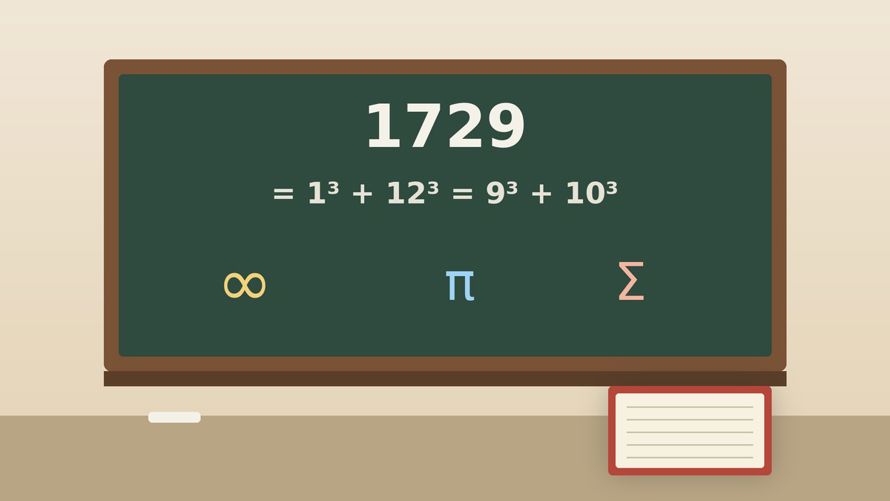
A favourite story: Hardy once visited Ramanujan, who was ill, and said that his taxi number, 1729, seemed rather dull. Ramanujan immediately replied that it was very interesting: it is the smallest number expressible as the sum of two cubes in two different ways (1³ + 12³ and 9³ + 10³). Since then, 1729 has been called the Hardy–Ramanujan number.
Illness and an Early Death
England’s cold climate, wartime food shortages and his strict vegetarian diet affected Ramanujan’s health. He fell seriously ill, returned to India in 1919, and died on 26 April 1920, aged only 32.
Even in his final months, he kept working. His notebooks, including a “lost notebook” rediscovered in 1976, contain ideas that mathematicians are still studying today, with applications in areas from number theory to physics.
What His Life Teaches Me
- Talent can come from anywhere: a small town, a poor family, a failed exam record.
- Systems often miss genius: our exams still reward all-round marks more than deep passion.
- Mentors matter: without Hardy’s openness, Ramanujan might have remained unknown.
- Passion drives discovery: he worked with joy, even through poverty and illness.
The Other View
Some historians point out that Ramanujan’s story is often romanticised as pure intuition, overlooking the hard work, the support of Indian mentors who helped him early, and the role of Hardy’s rigorous training in making his work usable. Others note that many of his results needed proofs by others. These points add balance. But for me, Ramanujan remains a powerful reminder to look carefully at the unusual student who doesn’t fit the system. The next genius might be failing an exam somewhere right now.

Working as Lead Data Scientist with ICL Services in Kazan. I have 11 years of experience in data analysis and machine learning, and earlier worked with BARS Group as Data Analyst. I graduated from Kazan Federal University with a bachelor's degree in Applied Mathematics and Physics and completed a master's degree in Data Science at Innopolis University. In my free time I like playing ice hockey and cooking.