First, second, third: the counting words that tell you where, not how many
"How many children are in the line?" and "Which child is third in the line?" sound similar, but they ask completely different things. The first is about quantity. The second is about position. Children learn the first kind of number early. The second kind, ordinal numbers, often needs a little more help.
First, Second, Third in Numbers & Sums is a short, clear game for exactly that.
How it works
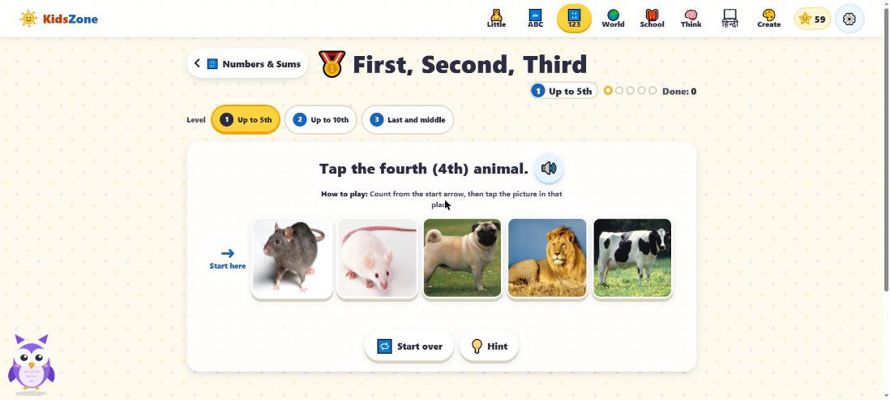
The screenshot shows a row of five animal photographs: a rat, a white mouse, a pug, a lion and a cow. On the left is a blue arrow marked Start here. The question says "Tap the fourth (4th) animal." Your child counts from the arrow, one, two, three, four, and taps the lion.
That little arrow is important. Position depends on where you start counting, and the game makes that visible every time.
Three levels
- Up to 5th: short rows, simple positions
- Up to 10th: longer rows, which wrap onto a second line on some screens, so your child learns to count along the top row and then the bottom row
- Last and middle: the trickier position words that don't have a number
"Last" and "middle" are interesting. A child has to look at the whole row to answer, not just count from the start. It's a nice small shift in thinking.
Why ordinals matter
Ordinal words are everywhere in school and daily life:
- "Turn to the second page."
- "You are third in the queue."
- "Our classroom is on the first floor."
- "Write your name on the last line."
A child who isn't sure what "third" means can quietly fall behind on instructions, even if they understand the work itself.
The tricky spellings
First, second and third don't follow the pattern. Fourth, fifth and sixth mostly do. Point out the short forms too: 1st, 2nd, 3rd, 4th. Many children find the little letters after the number fascinating once they notice them.
Practise in real queues
- At the bus stop or the bank, count the people ahead and ask your child which place you are in.
- When lining up toys, ask them to put the teddy fourth and the car last.
- Run a "race" between soft toys and announce the results: first, second, third.
Pair it with
Ordinals sit well alongside Story Order in Think & Remember, where children put pictures in sequence: first the seed, then the sprout, then the flower. That's ordinal thinking applied to stories.
Play First, Second, Third on KidsZone.

MindStick Software Pvt. Ltd. is a Microsoft Gold Partner in software application development. Our expertise is in software product design, custom programming, database design, web design and programming and cutting edge mobile applications development.