Empty and full, open and shut: teaching opposites from pictures to sentences
Opposites are one of the first ways children organise the world. Hot and cold. Day and night. Big and small. They understand these pairs long before they can explain them, and they love catching grown-ups out: "No, that's not big, that's small!"
Opposites on KidsZone builds on that instinct, starting with pictures and ending with full sentences.
How it works
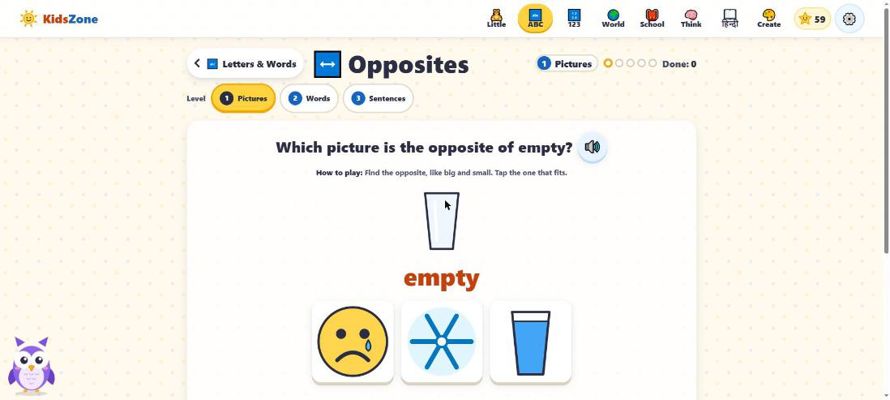
In the screenshot, the question is "Which picture is the opposite of empty?" At the top is an empty glass with the word empty. Below are three choices: a sad face, a snowflake and a full glass of water. Your child taps the full glass. The speaker reads everything aloud for children who need it.
I like that the wrong choices aren't random. A sad face and a snowflake make a child stop and think about what "opposite" really means, rather than just matching shapes.
Three levels
- Pictures: see it, choose the opposite picture
- Words: the choices are written words
- Sentences: the opposite has to fit inside a sentence
The sentence level is where opposites stop being a vocabulary list and become part of language. "The shop was open in the morning but ___ at night" asks a child to understand meaning, not just recall a pair.
Why opposites are worth the time
- They double vocabulary: every pair is two words learned together.
- They build comparison, a thinking skill used everywhere in maths and science.
- They show up in school exams from Class 1 onwards, often as "write the opposite" questions.
Bring them into the day
Opposites are everywhere at home, which makes them easy to practise without a screen:
- At the tap: "Is the water hot or cold?"
- With the lights: "Switch it on. Now off."
- On the stairs: "Are we going up or down?"
- At meals: "Is your plate full or empty?"
You'll find your child starts doing it back to you within a day or two.
A fun twist
Play "Opposite Day" for five minutes. Whatever you say, your child says the opposite. "I'm so tall!" "You're so short!" It usually ends in laughter, and laughter is a good sign that learning is happening.
If your child enjoys that kind of rule-flipping, Switch It! in Think & Remember has an "Opposite day" level of its own.

MindStick Software Pvt. Ltd. is a Microsoft Gold Partner in software application development. Our expertise is in software product design, custom programming, database design, web design and programming and cutting edge mobile applications development.