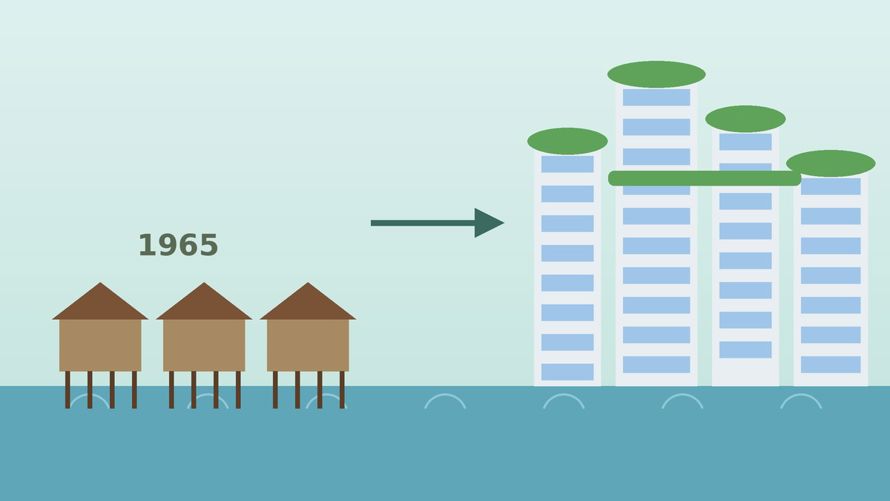
Lee Kuan Yew and How a Swamp Became Singapore
Every Indian who visits Singapore comes back with the same reaction: “Everything works.” The airport is spotless, the trains run on time, the streets are clean and safe. Many of us then ask, “Why can’t our cities be like this?” To answer that question, I believe we have to understand Lee Kuan Yew.
A Brilliant Young Lawyer
Lee Kuan Yew was born on 16 September 1923 in Singapore, then a British colony. He lived through the brutal Japanese occupation during the Second World War, which taught him how fragile life and order could be. He studied law at Cambridge, graduating with top honours.
Back in Singapore, he co-founded the People’s Action Party (PAP) in 1954 and became the first Prime Minister of self-governing Singapore in 1959.
The Tears of 1965
Singapore joined Malaysia in 1963, but political and racial tensions led to its separation on 9 August 1965. On television, Lee broke down in tears. Singapore was suddenly an independent country with no hinterland, no army to speak of, little fresh water and almost no natural resources. Many doubted it would survive.
Building a Nation From Scratch
Over the next decades, his government made bold choices:
- Attracting foreign investment: Singapore invited global companies to set up factories and offices, offering stability, skilled workers and efficient government.
- Public housing: The Housing and Development Board built flats on a massive scale. Today, a large majority of Singaporeans live in public housing, and most own their homes.
- Clean government: Lee made fighting corruption a priority, giving strong powers to the anti-corruption agency and paying ministers and civil servants well to reduce temptation.
- English as a common language, while keeping mother tongues like Mandarin, Malay and Tamil, so the economy could connect globally and different communities could communicate.
- Multiracial policies, including ethnic quotas in public housing, to prevent communal ghettos.
- Greening the city: Trees and parks became part of planning, creating a “city in a garden.”
By the 1990s, Singapore had become one of the world’s richest countries per person, with a world-class port, airport and financial centre.
The Strict Side
Lee’s Singapore was not a liberal democracy in the Western sense. His government:
- Restricted the press and public protests.
- Used defamation lawsuits against opposition politicians and critics.
- Maintained tough laws, including caning and strict penalties for drug offences.
- Was famous for rules on littering, spitting and even chewing gum.
Lee argued that a small, vulnerable, multi-ethnic nation needed discipline and stability more than open political competition. Critics saw this as authoritarianism.
His Connection to India
Lee admired India’s potential and was friendly with Indian leaders, but he was also frank about India’s slow bureaucracy and poor infrastructure. Singapore later became one of the largest sources of foreign investment in India and a partner in industrial parks and urban planning projects.
What India Can Learn
- Honest, competent government is the foundation of everything.
- Long-term planning for housing, water and transport pays off over decades.
- Strict enforcement of basic rules changes public behaviour.
- Merit-based civil services attract the best talent.
But India is a vast democracy of 1.4 billion people, not a city-state of a few million. We cannot copy Singapore’s methods wholesale, especially limits on free speech.
The Other View
Critics argue that Lee’s success came at the cost of political freedom, and that Singapore’s model depended on its small size and strategic location. Others say Singapore’s prosperity owes much to global trade conditions and not only to Lee. Supporters respond that many countries had similar chances but failed. I think both sides have a point. Lee Kuan Yew showed what determined, honest leadership can achieve. Whether a country should accept less freedom in return is a question every society must answer for itself.

I am an Officer Grade II at Allied Bank, Rawalpindi, with 6 years of experience in branch banking operations and trade finance. I completed my B.Com (Hons) from PMAS Arid Agriculture University, Rawalpindi. Outside work I enjoy watching football and reading Urdu poetry.