Small letters are the ones children actually read
Here's something that surprises many parents. Children usually learn capital letters first, because they're bigger, simpler and on every alphabet chart. But open any picture book and almost every letter on the page is small.
So a child who knows A, B and C perfectly can still feel lost in front of a real sentence. The Small Letters page on KidsZone is there to close that gap.
What the page looks like
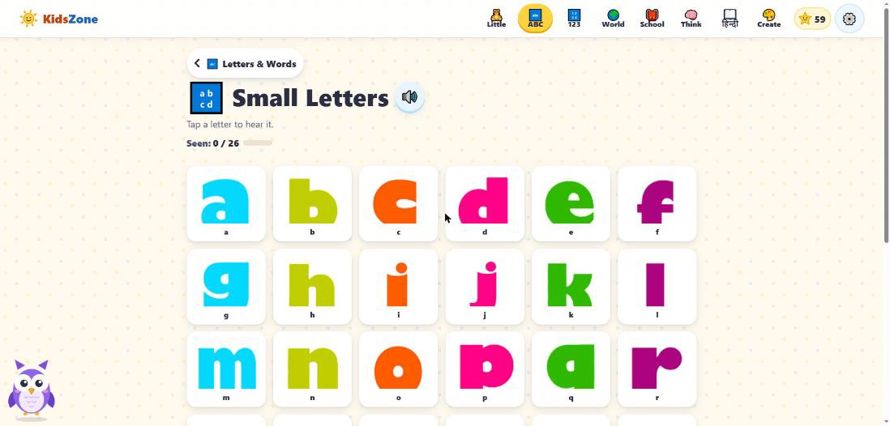
As the screenshot shows, it's a grid of all 26 lowercase letters in big, bold, bright colours: a turquoise a, a lime b, an orange c, a pink d. Each letter sits on its own card, large enough for small fingers.
Tap any letter and its name is read aloud. The Seen counter at the top tracks how many of the 26 your child has explored.
The tricky ones
A few small letters cause most of the confusion:
- b and d, which are mirror images
- p and q, the same story turned upside down
- n and u, one flipped over
- i, j and l, which look alike in many fonts
Spend a little extra time on these. Tap b, then d, and ask your child what's different. Some children find it helps to make a "bed" with their hands: left fist with the thumb up for b, right fist for d, and the word b-e-d sits between them.
Capital and small, side by side
The most useful thing you can do is connect each small letter with its capital. Open Capital Letters in one tab and this page in another, or simply ask, "What does big A look like? And small a?"
Some pairs look almost the same (Cc, Oo, Ss, Ww). Others look completely different (Aa, Gg, Rr). Children find it funny that one letter can have two such different shapes, and noticing that is real progress.
Off the screen
- Write a short grocery list in small letters and let your child "read" it with you in the shop.
- Point out small letters on biscuit packets and toothpaste tubes. Most brand names mix capitals and small letters, which makes them good practice.
- Write your child's name with a capital first letter and small letters after. It's the first real word most children learn to read.
What comes next
Once small letters feel familiar, your child is ready for First Sound, where letters start turning into sounds, and Sight Words Pop, where they meet the small words that fill every storybook.
Explore Small Letters on KidsZone. It's a small page, but it's the one that leads into real reading.
MindStick Software Pvt. Ltd. is a Microsoft Gold Partner in software application development. Our expertise is in software product design, custom programming, database design, web design and programming and cutting edge mobile applications development.