Why Made in India Phones Matter More Than You Think
I still remember the days when buying a phone in India meant buying something made in China, Korea or Taiwan. Indian brands like Micromax and Karbonn were popular for a while, but most of their phones were also built abroad. Phones were something we used, not something we made.
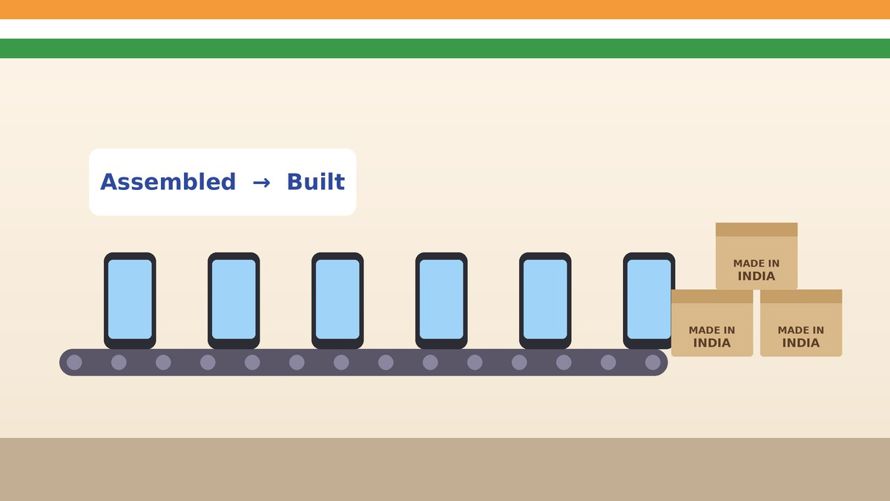
That has changed faster than many people realise. Today, the vast majority of smartphones sold in India are assembled in India, and India has become one of the world’s largest mobile phone manufacturers. iPhones made in Tamil Nadu and Karnataka are sold in New York, London and Dubai.
How It Happened
- Phased Manufacturing Programme from 2016 raised duties on imported phones and parts, encouraging local assembly.
- Production Linked Incentive (PLI) scheme, launched in 2020, paid companies a share of their increased production. This attracted Apple’s partners like Foxconn and Tata Electronics, along with Samsung, Dixon and others.
- A huge domestic market made it worthwhile for companies to build locally.
- The China plus one strategy: global companies wanted to reduce dependence on China, and India offered scale and political stability.
Smartphones have become one of India’s top export items, with exports worth tens of billions of dollars a year, led by iPhones.
Why It Matters
1. Jobs. Phone factories employ hundreds of thousands of people directly, many of them young women from rural and semi-urban areas. For many, it is their first formal job with a regular salary.
2. Skills. Working in high-precision manufacturing builds skills that spread into other industries: quality control, automation, supply chain management and engineering.
3. Exports and foreign exchange. Electronics exports reduce India’s trade deficit and make our economy less dependent on a few sectors.
4. Strategic security. Phones carry our payments, data and communication. Building them at home, and eventually building more of their components, reduces risk if supply chains are disrupted.
5. Global credibility. When the world’s most demanding companies trust Indian factories with flagship products, it changes how the world sees “Made in India.”
The Honest Problem: Low Value Addition
Here is where I want to be careful not to overstate the success. Much of what India does today is assembly. The most valuable parts, such as chips, displays, camera modules and many components, are still imported, often from China. The share of value created in India has been rising, but it remains modest.
That means India earns less from each phone than the headline export numbers suggest. Real success will come when we make more of the parts too.
What India Is Doing Next
The government has launched schemes to support electronic component manufacturing and semiconductor plants. Companies are setting up factories for displays, batteries, enclosures and chip packaging. Tata, Micron and others are building semiconductor facilities in Gujarat and Assam. These projects take years, but they are the right direction.
What Still Needs to Improve
- Faster approvals and stable policies, so investors trust India for the long term.
- Better infrastructure, especially power, ports and logistics near industrial clusters.
- Skilling at scale, with ITIs and polytechnics teaching modern manufacturing.
- Reasonable tariffs on components, so local assembly does not become too expensive.
- Indian brands. Most phones made here still carry foreign brand names. I hope to see a new generation of Indian phone brands that can compete globally.
The Other View
Critics argue that the PLI scheme spends taxpayers’ money mainly to benefit foreign companies, and that low value addition makes the export numbers misleading. Others say India should focus on its strengths in services and software instead of competing with China in manufacturing. These criticisms deserve attention. But I believe a country of India’s size cannot rely only on services. Phones are the starting point, not the destination. If we build the skills, factories and supply chains now, the deeper value will follow.

Working as Senior Mechanical Engineer with Forward Sports in Sialkot. I have 6 years of experience in plant maintenance and production planning, and earlier worked with Pak Suzuki Motor Company as Mechanical Engineer. I did my BE Mechanical Engineering from Mehran University of Engineering and Technology. In my free time I like watching football and playing squash.