California’s Housing Crisis Explained Simply
If you want to understand California’s housing crisis, start with a simple sentence: too many people want to live there and the state has not built enough homes for them. Everything else is detail. But the details explain why such a rich state finds it so hard to fix such a basic problem.
How Expensive Is It?
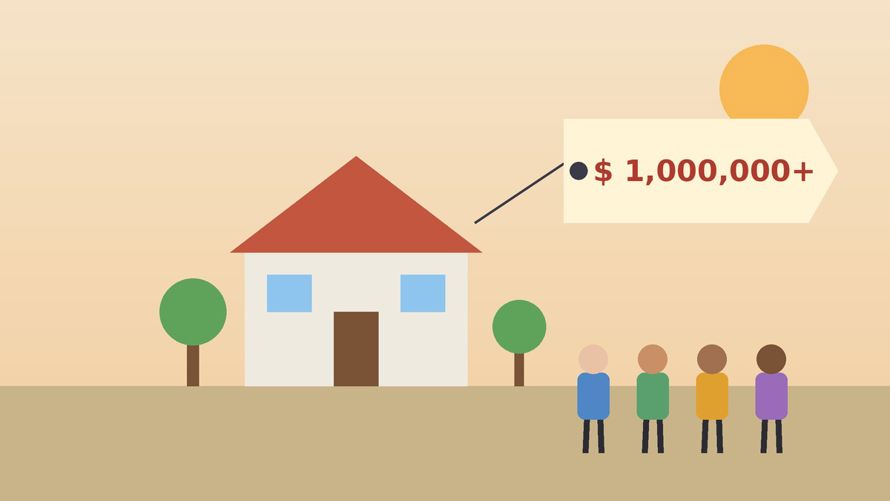
The median price of a house in California sits far above the national figure, often more than double it in recent years. In places like San Jose, San Francisco and parts of Los Angeles, a modest family home can cost well over a million dollars. Rents follow the same pattern. Teachers, nurses, police officers and restaurant workers often commute two hours each way because they cannot afford to live where they work.
The state itself has estimated that it needs millions of additional homes to catch up. That is not a small shortfall. It is decades of under-building.
Reason One: Rules That Say No
For much of the twentieth century, California cities zoned most residential land for single-family homes only. A big apartment building, or even a small fourplex, was simply not allowed on most streets. As jobs boomed in tech, entertainment and trade, the number of homes grew far more slowly than the number of workers.
Reason Two: Too Many Ways to Delay
Even where building is allowed, projects face long approvals, design reviews, public hearings and lawsuits. California’s environmental review law, known as CEQA, was meant to protect nature but was often used by neighbours to block or delay housing, even infill apartments on empty city lots. Every year of delay adds cost, and those costs end up in rents.
Reason Three: Prop 13
In 1978, California voters passed Proposition 13, which capped property taxes based on the purchase price. It protected older homeowners from rising tax bills, which was its purpose. But it also gave owners a strong reason never to sell, and it pushed cities to prefer shops and offices, which bring sales tax, over housing, which brings new costs. Many experts think it quietly made the shortage worse.
Reason Four: NIMBY Politics
NIMBY stands for “Not In My Back Yard.” Many people support affordable housing in general but oppose it on their street because of traffic, parking, shadows or “neighbourhood character.” Since local residents vote and future residents do not, local politics often favours saying no.
Things Are Starting to Shift
I find it encouraging that California has started to change course. Over the last few years the state has:
- Allowed backyard homes (ADUs) almost everywhere, and many thousands have been built.
- Let owners split lots and build up to four units on single-family land.
- In 2025, exempted many urban infill housing projects from CEQA reviews.
- Passed SB 79 in 2025, allowing taller apartment buildings near major transit stops.
A growing YIMBY (“Yes In My Back Yard”) movement, led by younger renters, has turned housing into a real political issue.
What I Think Still Needs to Happen
- Cities must actually approve projects quickly, not just pass laws on paper.
- Construction costs need attention, including faster permits and new building methods.
- After the 2025 Los Angeles fires destroyed thousands of homes, rebuilding must be safer and faster at the same time.
- Renters need protection during the transition so that new building does not push out existing communities.
The Other View
Some Californians argue that dense building will spoil neighbourhoods, overload roads and water, and that the state is overriding local democracy. Others point out that high costs, not rules alone, make new homes expensive, and that the market will never build for the poorest people without subsidy. These worries deserve answers. But from where I stand, a state where nurses cannot afford to live near their hospital has already made its choice between perfect neighbourhoods and fair ones. It is time to build.

I am the Head of Logistics at DHL, Katowice, with 14 years of experience in warehousing and transport. I graduated from the University of Economics in Katowice with a bachelor's degree in Logistics and completed a master's degree in Logistics at the same university. Outside work I enjoy skiing in Zakopane and running.