Coding before keyboards: take Hoot to the nest
Children don't need a laptop to start thinking like a programmer. They need to plan a sequence of steps, run it, and check whether it worked. That's really all a computer program is.
As someone who has written code for more than twenty years, I can tell you the most useful habit a programmer has isn't knowing a language. It's breaking a problem into small, clear steps. And that habit can start at five.
How Hoot's Path works
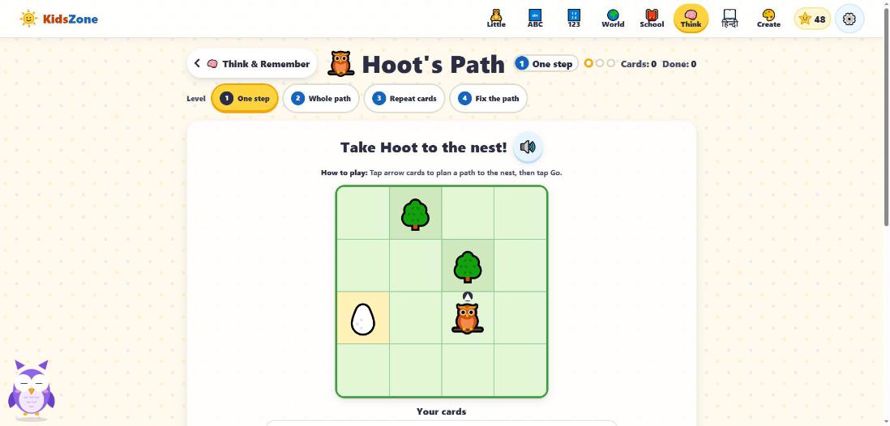
In Hoot's Path, Hoot the owl needs to get back to the nest. The screenshot shows a small green grid with a couple of trees in the way, Hoot in the middle, and the egg in its nest a few squares away.
Your child plans the route by tapping arrow cards: up, down, left, right. Then they tap Go and watch Hoot follow the plan, step by step. If the plan is right, Hoot reaches the nest. If not, Hoot ends up somewhere else, and your child has to work out where the plan went wrong.
That last part, finding the mistake, is exactly what programmers call debugging.
Four levels that mirror real coding ideas
The levels are cleverly chosen:
- One step: a single move, to learn how the cards work
- Whole path: plan the entire route before pressing Go, which is sequencing
- Repeat cards: use a card that repeats a move, which is the idea of a loop
- Fix the path: a plan is given with a mistake in it, and your child fixes it, which is debugging
Sequencing, loops and debugging are three of the core ideas in any beginner coding course. Here they are, taught with an owl and an egg.
Follow Hoot and Maze Run
Two other games in Think & Remember fit nicely alongside.
Follow Hoot flips the idea around: watch what Hoot does, then repeat it. That's memory and attention working together.
Maze Run is the classic: find the way from start to finish without hitting a wall. Children who rush learn quickly that it pays to look ahead.
Try it at home without a screen
Play "robot" with your child. You're the robot, and you can only follow exact instructions: "two steps forward, turn left, one step forward". If they say "go to the kitchen", you stand still, because robots don't understand that. Children find this hilarious, and they learn very quickly why programmers need to be precise.
Then come back to Hoot's Path and see how much better their plans are.
Don't worry if the Repeat cards level takes a while to click. The idea of a loop, doing the same thing several times with one instruction, is genuinely new for young children. Let them experiment, watch Hoot go the wrong way, and try again. That trial and error is exactly how programmers learn too.

Working as Lead Developer with Ciena in Ottawa. I have 11 years of experience in web development with React and Node.js, and earlier worked with Kinaxis as Web Developer. I graduated from Algonquin College with a diploma in Computer Programming. In my free time I like running and skiing.