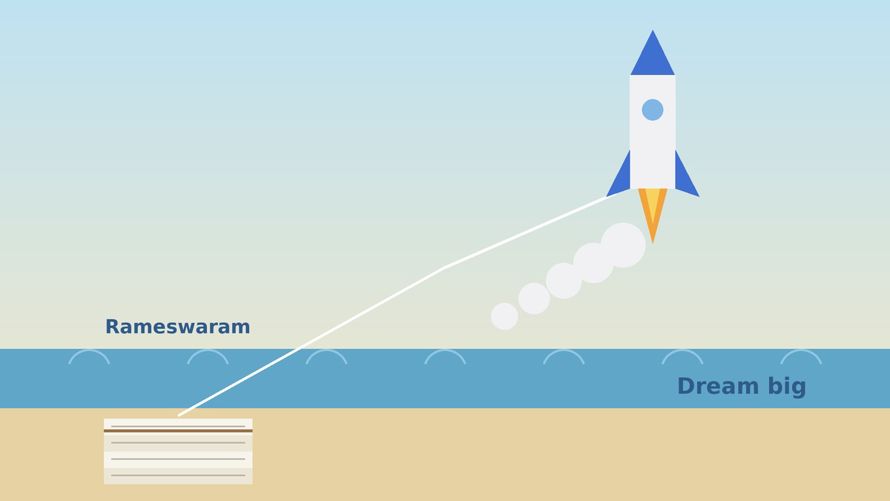
Dr A.P.J. Abdul Kalam, From Selling Newspapers in Rameswaram to Rashtrapati Bhavan
I have watched many recordings of Dr Kalam speaking to halls full of students. He did not lecture like a former President. He asked questions, made the children repeat promises after him and laughed with them. By the end, every child in the hall seemed to sit a little straighter. That is the effect he had on people.
A Simple Beginning
Avul Pakir Jainulabdeen Abdul Kalam was born on 15 October 1931 in Rameswaram, Tamil Nadu. His father owned a boat and was the imam of a local mosque. The family was not wealthy. As a boy, Kalam sold newspapers early in the morning to help support them.
He grew up in a town where Hindu and Muslim families lived closely together. His childhood friends included the son of the temple priest. Kalam often spoke of this harmony as something that shaped his outlook.
Dreaming of Flight
He was fascinated by birds and flight. He studied physics in Tiruchirappalli and then aerospace engineering at the Madras Institute of Technology. His dream of becoming a fighter pilot ended when he narrowly missed selection by the Indian Air Force. Disappointed, he turned to science instead. India’s rocket programme gained what the air force missed.
Building India’s Rockets
At ISRO, Kalam was project director of the SLV-3, India’s first indigenous satellite launch vehicle. Its first flight in 1979 failed, and he took the blame publicly. In 1980, SLV-3 successfully placed the Rohini satellite in orbit. He often told the story of how his leader, Satish Dhawan, took responsibility for the failure but let Kalam present the success, a lesson in leadership he never forgot.
The Missile Man
At the Defence Research and Development Organisation (DRDO), Kalam led India’s Integrated Guided Missile Development Programme, which developed missiles like Agni and Prithvi. He became known as the “Missile Man of India.” He also played a key role in the Pokhran-II nuclear tests in 1998.
The People’s President
In 2002, Kalam became India’s 11th President. He was not a career politician, and he brought a different spirit to Rashtrapati Bhavan. He opened its doors to students, answered emails from children, and travelled widely to schools and colleges. People called him the “People’s President.”
After his term ended in 2007, he returned to teaching and lecturing. He died on 27 July 2015 while delivering a lecture to students at IIM Shillong, doing what he loved most until the very end.
Why Children Loved Him
- He believed in them. He told children to dream big and that dreams are what keep you awake, not what you see in sleep.
- He was humble. Despite his achievements, he lived simply, with few possessions.
- He made science exciting. His books, especially his autobiography Wings of Fire, inspired countless students to choose science and engineering.
- He represented possibility. A boy from a small coastal town, from a modest family, reached the highest office in the country.
What His Life Teaches Me
- Failure is part of success, as long as you learn from it.
- Good leaders share credit and take blame.
- Education and hard work can open any door.
- Unity and respect among communities make a nation strong.
The Other View
Some critics argue that Kalam’s presidency was more symbolic than substantive, and that he avoided taking strong positions on controversial issues. Others, especially those who oppose nuclear weapons, criticise his role in India’s missile and nuclear programmes. These views deserve respect. But I believe Kalam’s greatest contribution was the confidence he gave to young Indians. Few leaders have inspired so many children to look up at the sky and believe they could reach it.

I am a Lead Data Scientist at Selectel, Saint Petersburg, with 12 years of experience in data analysis and machine learning. I graduated from Bauman Moscow State Technical University with a bachelor's degree in Applied Mathematics and Physics and completed a master's degree in Data Science at ITMO University. I am originally from Moscow. Outside work I enjoy travelling around the Golden Ring and photography.