Rupee Shop: maths with the money kids actually see
At some point every child asks, "Why do I need to learn this?" With money, the answer is easy. They see it every day, at the kirana store, the vegetable cart, the auto stand.
The trouble is that many maths books and apps teach money with dollars and cents, which an Indian child has never held. Rupee Shop on KidsZone uses rupees.
How it works
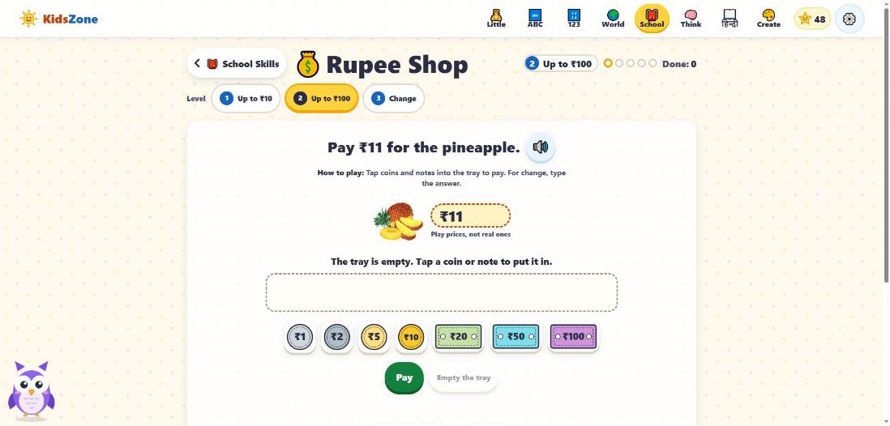
The screenshot shows a typical question: "Pay ₹11 for the pineapple." Below it is an empty tray, and below that are coins and notes: ₹1, ₹2, ₹5 and ₹10 coins, and ₹20, ₹50 and ₹100 notes.
Your child taps coins and notes to put them in the tray until they've made ₹11, then taps Pay. If they make a mistake, Empty the tray lets them start again.
There's even a tiny label under the price reminding everyone that these are play prices, not real ones. A nice touch for children who might otherwise wonder why pineapples are so cheap.
Why this is good maths
Making ₹11 can be done in many ways: a ₹10 coin and a ₹1 coin, or two ₹5 coins and a ₹1, or a ₹5, three ₹2 coins... Children quickly discover that some ways are faster than others, and that's real problem-solving.
Three levels
- Up to ₹10: small amounts, coins only in practice
- Up to ₹100: bigger amounts using notes too
- Change: working out how much comes back, which is where many adults still reach for their phone
Story Sums and more
In the same School Skills section, Story Sums puts sums inside short stories. Word problems are where many children lose marks, not because the maths is hard but because they have to work out what the question is asking. Practising with small stories helps.
Two more worth a look: Fill the Gap for completing sentences, and My Quiz.
The real-world follow-up
Next time you go shopping, hand your child a ₹20 note for something that costs ₹15 and ask how much change to expect before the shopkeeper hands it over. Let them count the coins. Then praise the effort, whether they got it right or not.
A child who is comfortable with money is a child who's a little more ready for the world.
Money and responsibility
Money games are also a good way to start conversations about saving and spending. After a round in the Rupee Shop, ask your child: "If you had ₹100, what would you buy? What would you save?" There are no wrong answers. You're simply helping them see that money is limited and choices matter. Those early conversations shape habits that last a lifetime, and they're much easier to have when the money is play money.
Start at the first level, even with an older child, and move up as soon as it feels easy.
Visit the Rupee Shop on KidsZone.

Hi, Deepesh Mishra, this side. I'm a professional content writer, and I also have good knowledge in digital marketing and SEO. I have 2+ years of experience as a content writer and digital marketer with SEO.