When sums get bigger: place value with blocks
Somewhere around Class 1 or Class 2, sums jump from 3 + 4 to 34 + 25. For many children, this is the moment maths stops feeling friendly.
Usually the real problem isn't the adding. It's place value: understanding that the 3 in 34 means thirty, not three. A child who doesn't feel that difference will add digits in the wrong columns, get answers that make no sense, and decide they're "bad at maths". They're not. They just need place value to click.
Blocks make it visible
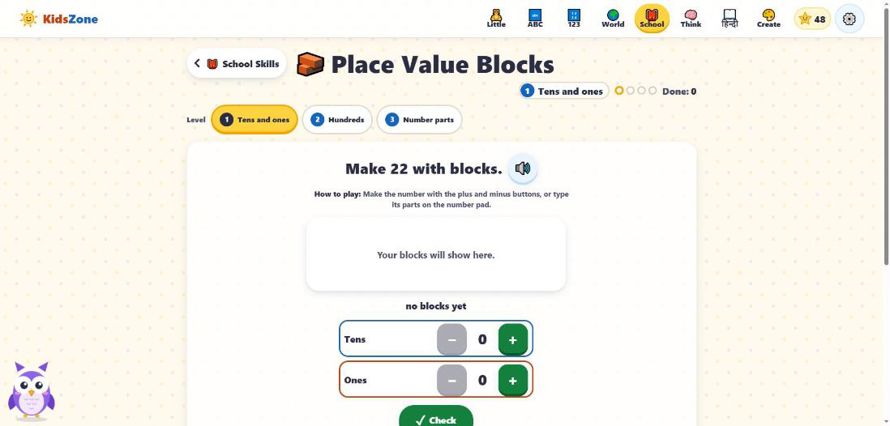
Place Value Blocks on KidsZone uses the same idea teachers use with physical blocks. In the screenshot, the question is "Make 22 with blocks." Below are two rows, one for Tens and one for Ones, each with a minus and a plus button.
Your child presses plus on Tens twice and plus on Ones twice. As they do, blocks appear in the display: two long tens and two small ones. Then they press Check.
That's the key moment. They can see that 22 is two tens and two ones, not just two 2s next to each other. They can also type the parts on the number pad if they prefer.
Three levels
- Tens and ones: two-digit numbers, the essential starting point
- Hundreds: three-digit numbers, for Class 2 and Class 3
- Number parts: breaking numbers into their parts in different ways, which builds flexible thinking
Then move to bigger sums
Once place value feels solid, the next two games in the School Skills section give plenty of practice:
- Big Adding for two-digit addition
- Big Take Away for two-digit subtraction
Because your child now understands what each digit means, these sums stop being a set of rules to memorise and start making sense.
If homework is a struggle
Here's my honest advice. If your child is struggling with two-digit sums, don't push more sums at them. Go back one step and play Place Value Blocks for a few days, even if it feels like going backwards. Most of the time, that's where the gap is.
You can do the same with real objects at home. Bundle ten ice-cream sticks with a rubber band to make a "ten", keep a few loose ones as "ones", and ask your child to make 34. Then let KidsZone keep the practice going.
Money is place value too
If your child enjoys Place Value Blocks, connect it to money. A ₹10 note is one ten, a ₹1 coin is one one. Ask them to make ₹34 with tens and ones, and they're doing exactly the same thinking as in the game. The Rupee Shop in the same section makes a great follow-up once place value feels comfortable.
A few minutes a day with the blocks, over two or three weeks, usually makes a visible difference in homework.
Try Place Value Blocks on KidsZone.

I am a Lead Data Scientist at Selectel, Saint Petersburg, with 12 years of experience in data analysis and machine learning. I graduated from Bauman Moscow State Technical University with a bachelor's degree in Applied Mathematics and Physics and completed a master's degree in Data Science at ITMO University. I am originally from Moscow. Outside work I enjoy travelling around the Golden Ring and photography.