Number bonds: the small idea that makes mental maths fast
Watch a child add 8 + 7. Many will hold up eight fingers, then count on seven more, running out of fingers and starting to look worried. Now watch a child who knows number bonds. They think: 8 and 2 make 10, and 5 more makes 15. Done in a second, no fingers needed.
That's the power of number bonds, and it's why they're worth practising early.
What is a number bond?
A number bond is simply a pair of numbers that make another number. 7 and 3 make 10. 6 and 4 make 10. 12 and 8 make 20. When children know these pairs by heart, adding and subtracting become much faster, because they stop counting and start recognising.
How the game works
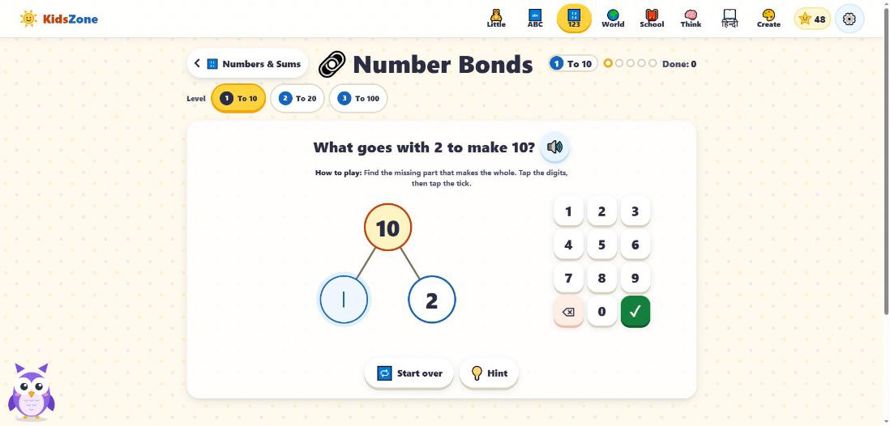
Number Bonds on KidsZone shows the classic part-whole diagram that many schools use. In the screenshot, the whole is 10 at the top, one part is 2, and the other part is empty. The question asks: what goes with 2 to make 10?
Your child types the answer on the big number pad and taps the green tick. If they're stuck, there's a Hint button.
The diagram matters. Seeing the whole split into two parts helps children understand that addition and subtraction are two sides of the same idea. 2 + 8 = 10, and 10 − 2 = 8. Same bond, two directions.
Three levels
- To 10: the essential pairs every child should know
- To 20: the next step, for Class 1 and Class 2
- To 100: pairs like 30 and 70, or 45 and 55, which make mental maths with bigger numbers much easier
Two more games worth a look
In the same Numbers & Sums section you'll find two more small games with big payoffs.
Shape Hunt is about circles, squares and triangles. After playing it, go on a real shape hunt at home. The clock is a circle, the window is a rectangle, a samosa is a triangle.
1st, 2nd, 3rd teaches ordinal numbers, the words for position. Who came first in the race? Which floor do we live on? Children need these words long before they meet them in a textbook.
A tip for parents
Pick one number a week, say 10, and use it everywhere. "We have 10 rotis. I ate 3. How many for you?" "There are 10 steps. We've climbed 6. How many more?" By the end of the week, the bonds of 10 will be automatic, and you'll have done it without a single worksheet.
Number bonds also help with subtraction anxiety. A child who knows that 10 is 7 and 3 doesn't panic at 10 − 7, because the answer is already familiar. That calm confidence is worth more than speed.

Working as Lead Data Scientist with ICL Services in Kazan. I have 11 years of experience in data analysis and machine learning, and earlier worked with BARS Group as Data Analyst. I graduated from Kazan Federal University with a bachelor's degree in Applied Mathematics and Physics and completed a master's degree in Data Science at Innopolis University. In my free time I like playing ice hockey and cooking.