Steve Jobs, Fired From His Own Company and Back to Change It
I have used many technology products in my career, but very few changed how I worked as much as the smartphone. When I look at the history of that device, one name keeps coming up: Steve Jobs. What interests me most about him, though, is not the iPhone. It is the years when everything went wrong.
An Adopted Child Who Questioned Everything
Steve Jobs was born on 24 February 1955 in San Francisco and adopted as a baby by Paul and Clara Jobs. His father was a machinist who taught him to care about craftsmanship, even on the parts of a cabinet no one would see.
Jobs dropped out of Reed College after one semester but stayed on campus, attending classes that interested him. One was a calligraphy course. Years later, he said that course influenced the beautiful fonts on the first Macintosh.
A Journey to India
In 1974, young Jobs travelled to India seeking spiritual insight. He spent months wandering, visited an ashram in the Himalayan foothills, and returned with a shaved head and an interest in Zen Buddhism and intuition. He later said that the trip shaped how he thought about simplicity and focus.
The Garage and the Rise
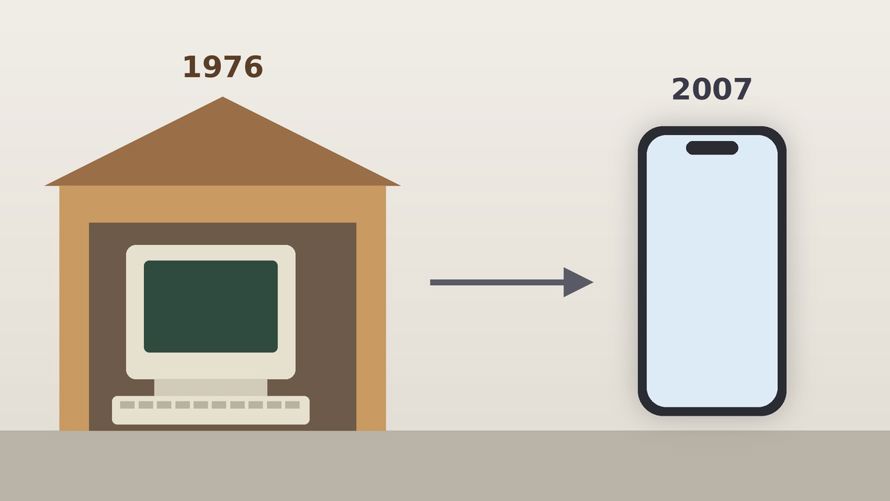
In 1976, Jobs and Steve Wozniak founded Apple in the Jobs family garage. Wozniak was the engineering genius; Jobs saw how to turn his work into products people wanted. The Apple II became a huge success. In 1984, Apple launched the Macintosh, one of the first popular computers with a graphical interface and a mouse.
Fired at Thirty
Jobs was brilliant but difficult. He clashed with colleagues and with John Sculley, the CEO he had personally recruited. In 1985, Apple’s board sided with Sculley, and Jobs was pushed out of the company he had co-founded.
He later described it as devastating. He was 30, very public and suddenly without the work that defined him.
The Wilderness Years
What he did next is the part I find most instructive.
- He founded NeXT, a computer company for education and business. It was not a commercial hit, but its software was advanced.
- He bought a small graphics company from Lucasfilm that became Pixar. In 1995, Pixar released Toy Story, the first fully computer-animated feature film. Pixar went on to make many beloved films.
Jobs later said that being fired from Apple was the best thing that could have happened to him, because it freed him to be a beginner again.
The Comeback
By the mid-1990s, Apple was in serious trouble, close to running out of money. In late 1996, it bought NeXT, and Jobs returned. Within a few years, he:
- Cut the product line down to a few focused products.
- Launched the colourful iMac in 1998.
- Introduced the iPod and iTunes in 2001, changing the music industry.
- Unveiled the iPhone in 2007, which reshaped the entire phone and internet industry.
- Launched the iPad in 2010.
Apple went from near-bankruptcy to one of the most valuable companies in the world.
Illness and Death
Jobs was diagnosed with a rare form of pancreatic cancer in 2003. He continued working through treatment and gave a famous commencement speech at Stanford in 2005, talking about connecting the dots, love and loss, and death. He died on 5 October 2011, aged 56.
The Flaws
Jobs could be harsh, demanding and sometimes cruel to employees. For years, he denied paternity of his first daughter. Critics also questioned working conditions in factories that made Apple products. Admiring his achievements shouldn’t mean ignoring these sides.
What His Life Teaches Me
- Failure can be a beginning. Being fired led to Pixar and his greatest comeback.
- Focus means saying no to many good ideas.
- Design and simplicity matter. People value products that are easy and beautiful to use.
- Connect your experiences. Calligraphy, India and animation all fed into his later work.
The Other View
Some argue that Jobs gets too much credit for work done by engineers and designers like Wozniak and Jony Ive, and that his management style should not be copied. Others see Apple’s closed ecosystem as bad for consumers. These views are worth hearing. But for me, the most powerful lesson of Jobs’s life is simple: losing your job, even a job you created, does not have to be the end of your story.

I am a Senior Software Engineer at Deliveroo, London, with 5 years of experience in backend services and cloud infrastructure. I graduated from Imperial College London with a BSc in Computer Science. Outside work I enjoy cooking and reading.