The hungry crocodile always eats the bigger number
Many of us learned "greater than" and "less than" from a drawing of a crocodile. Its mouth always opens towards the bigger number, because the crocodile is hungry and wants to eat more. It's an old classroom trick, and it still works beautifully.
KidsZone builds a whole game around it.
How it works
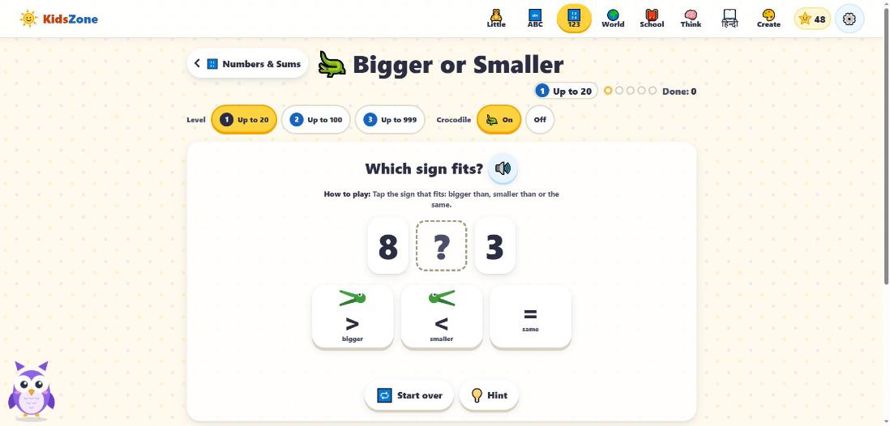
In Bigger or Smaller, two numbers appear with a question mark between them. Your child taps the sign that fits: bigger than (>), smaller than (<), or the same (=).
In the screenshot, the numbers are 8 and 3. Above the > and < signs sits a little green crocodile with its mouth open, so your child can literally see which way the mouth should face. Eight is bigger, so the crocodile opens towards the 8.
The crocodile switch
Here's a thoughtful detail. There's a Crocodile option you can turn On or Off. With it on, the crocodile helps. With it off, your child sees only the plain maths signs, just like in a school exam.
That's exactly how good teaching works. Start with a support, then take it away once the idea has sunk in. You can switch the crocodile off when you think your child is ready, and see whether they still get it right.
Three levels
- Up to 20: small numbers, perfect for Class 1
- Up to 100: two-digit comparisons, where place value starts to matter
- Up to 999: three-digit numbers for older children
Comparing numbers seems small, but it's a building block for almost everything later: subtraction, money, measurement, even reading a graph. A child who can quickly tell that 307 is smaller than 370 has understood something important about how numbers work.
Before & After
Its neighbour in the section is Before & After, which asks what comes just before or just after a number. What comes after 39? Plenty of children pause there, or say "thirty-ten". This game helps that particular confusion fade.
Five minutes each
These two games are quick. Five minutes of each is a good routine for the time between homework and dinner, and they're also nice for a quick revision the morning of a maths test.
And if your child enjoys the crocodile, tell them the story behind it. Children remember a hungry crocodile far longer than they remember "the symbol points to the smaller number".
Comparing in everyday life
Bring comparing into your day. At the shop: "This pack has 12 biscuits, that one has 20. Which has more?" On the road: "That bus is number 34, this one is 43. Which number is bigger?" These little questions take five seconds and keep the idea alive long after the game is closed. Before long your child will start asking you the questions.
Both games are free, have no ads, and save progress only on your own device.

Hi, this is Amrit Chandran. I'm a professional content writer. I have 3+ years of experience in content writing. I write content like Articles, Blogs, and Views (Opinion based content on political and controversial).