"Five more minutes" means nothing until a child can read a clock
Every parent has said it. "Five more minutes, then bath." And every child has replied, about ninety seconds later, "Has it been five minutes yet?"
Time is abstract for children. They can't see it or hold it. A clock face makes it a little more concrete, but only if they can read one, and that's a skill that's quietly disappearing now that every phone and microwave shows digital time.
How the Clock game works
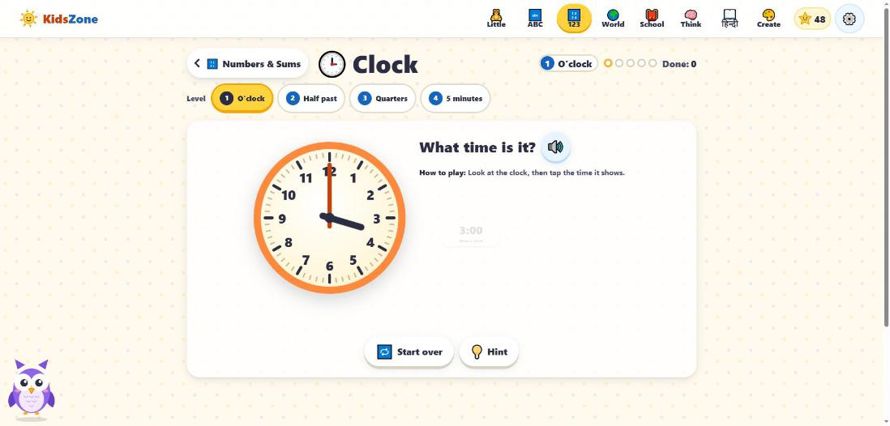
The Clock game on KidsZone shows a large, friendly analogue clock, the kind with a big hand and a small hand. Your child looks at it and taps the time it shows. In the screenshot, the clock shows three o'clock.
That's the whole game, and it's enough. The clock face is big and clear, with every number from 1 to 12 easy to read, so even a five-year-old can focus on what the hands are doing.
Four levels, the way schools teach it
The levels follow the order most teachers use:
- O'clock: the big hand on 12, read the small hand
- Half past: the big hand on 6
- Quarters: quarter past and quarter to
- 5 minutes: any five-minute time, like 4:25
Moving through them one by one builds real understanding instead of guesswork. Don't rush. Many children need a few weeks on o'clock and half past before quarters make sense.
Days and months too
Once clock reading is comfortable, try Days & Months in the School Skills section. Knowing that Wednesday comes after Tuesday, or which month comes before December, gives children a sense of how time is arranged over weeks and years, not just hours.
Make time visible at home
Here's what helps most. Put a simple wall clock with hands where your child can see it, at their eye level if possible. Then change how you talk about time:
- Instead of "five more minutes", say "when the big hand reaches the 6".
- Instead of "bedtime soon", say "bedtime is at 8 o'clock, show me where the small hand will be".
Within a couple of weeks, your child will be checking the clock themselves. You'll hear far fewer "is it time yet?" questions, and they'll have learned a life skill without a single lesson.
Why analogue still matters
You might wonder whether learning an analogue clock is worth it in a digital world. It is. An analogue clock shows time as a circle, so a child can see how much of the hour has gone and how much is left. "Half past" literally looks like half the clock. That picture of time helps children plan, wait and understand "how long" in a way a digital number never quite does. And of course, clock questions still appear in school exams.

Hi, Deepesh Mishra, this side. I'm a professional content writer, and I also have good knowledge in digital marketing and SEO. I have 2+ years of experience as a content writer and digital marketer with SEO.