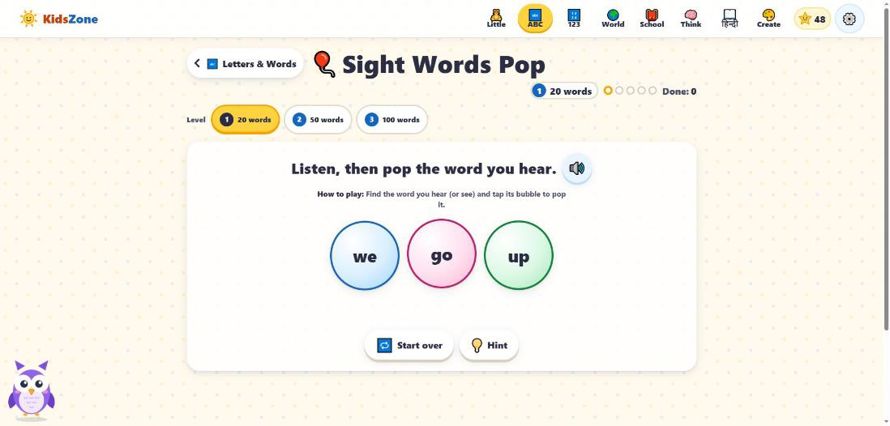
Sight Words Pop: listen, find, pop
Open any simple storybook and count the words. You'll find that a small set of words shows up again and again: the, is, and, we, go, up, said, was. Teachers call them sight words, because children need to recognise them instantly, on sight, rather than sounding them out letter by letter.
Many of them can't be sounded out easily anyway. Try explaining to a five-year-old why "said" isn't pronounced "sayd". The quicker route is simply to recognise them.
How the game works
In Sight Words Pop, a few words float in big colourful bubbles. The game says one of them aloud, and your child pops the bubble with that word.
In the screenshot, the bubbles say "we", "go" and "up". These are exactly the kind of tiny words that appear in every early reader. Hearing the word and then finding it connects sound with print, which is what reading is.
The popping matters too. It sounds like a small thing, but children love it, and that satisfying pop is why they'll ask for "one more round".
Three levels
- 20 words: the most common sight words, ideal for a first start
- 50 words: a bigger set for children who've got the basics
- 100 words: a solid foundation for independent reading
A child who knows a hundred sight words can read a surprising amount of a simple book on their own. That first "I read it myself!" moment is worth working towards, and this game makes the road there feel like play.
Opposites: two words for the price of one
Right beside it in Letters & Words is Opposites. Big and small, hot and cold, up and down, open and closed. Children understand these ideas long before they can read the words, which makes opposites a natural way into vocabulary. Each pair teaches two words at once.
A simple routine
- Play Sight Words Pop for five minutes after school.
- At bedtime, open a picture book and ask your child to point to any word they "popped" today.
- Celebrate every one they find.
The second step is the important one. It shows your child that the words in the game are the same words in real books, and that they can now read them.
Use the levels as milestones
The three levels make natural milestones. Finishing 20 words is a real achievement for a child who's just starting school. Reaching 50 is worth a small celebration. Getting through 100 means your child can recognise most of the little words in a simple storybook. Mark each one: a special story at bedtime, a note on the fridge, a phone call to a grandparent to share the news. Milestones that are noticed become milestones children want to reach again.
Like every KidsZone game, it's free, with no ads and no sign-up, so you can start tonight.

Passionate about natural things like feeling the reverberation of trees in the first light of the morning and listening to the cheering of birds when they sing in the morning. I am also a coffer of words or a "Writer" and used to write about nature's poetries.