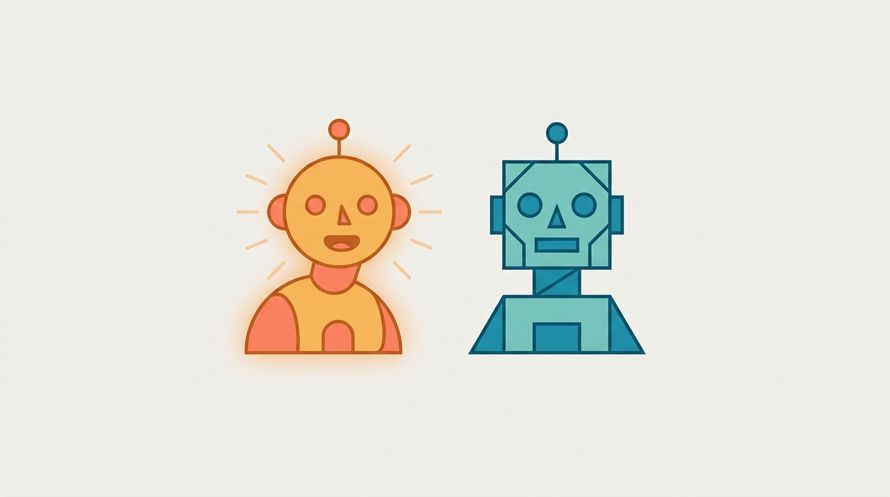
AI Confidence Is a Design Decision, Not a Personality Trait
When an AI assistant gives a polished answer, people often describe it as confident. That sounds like a quality of the model, almost like a personality trait. But confidence is also something the product interface creates: through fluent wording, tidy formatting, fast responses, and the absence of visible uncertainty or sources.
That matters because users do not meet a model’s internal probabilities. They meet a screen. A neatly written paragraph can feel well-supported even when it is a plausible guess, while a cautious answer can feel less capable even when it is more honest. The interface quietly teaches people how much trust to place in the system.
Fluency can look like evidence
People use presentation as a shortcut for judging reliability. In ordinary conversation, clear and specific explanations often come from someone who knows the subject. AI can reproduce that style without having checked whether every detail is correct. A response that names a date, a product setting, or a legal term may sound especially convincing simply because it is concrete.
This is not just a problem of users being careless. The product is asking them to make a difficult judgment with limited information. If an assistant gives no indication of where a claim came from, whether it searched current sources, or which part of the answer is uncertain, the user has little to work with besides tone.
Trust needs more than a disclaimer
Adding a permanent note that AI can make mistakes is a weak substitute for useful context. It puts the burden on people to remember a broad warning while they read specific, confident answers. A better design makes relevant limits visible at the moment they matter.
For instance, an assistant could distinguish between information it retrieved from current sources and information it is generating from prior knowledge. It could attach citations to the particular claims they support, rather than presenting a list of links that may or may not back up the whole response. For a time-sensitive question, it could show when the information was checked. These signals help users assess an answer without pretending that a label can guarantee it is correct.
Good uncertainty design also has to be specific. “I may be wrong” is not much help. “I found two sources that disagree on the launch date” tells the user what to check. “This depends on your operating system version” points to the missing detail. The goal is not to make every answer sound hesitant; it is to show where a decision or verification would change the result.
Make checking part of the experience
For high-stakes topics, an answer should not be a dead end. A user asking about a medical symptom, a financial obligation, or a workplace policy may need to know which details are general and which require a qualified person or an authoritative source. The interface can make those next steps easier: show the relevant source, identify the assumptions, and invite the user to supply missing context.
That is different from burying a warning beneath the conversation. It treats verification as part of using the product, much like reviewing a payment before sending it. The amount of friction should fit the consequences. A questionable movie recommendation does not need the same treatment as a claim about medication dosage.
There is a commercial tension here. Smooth answers are satisfying, and visible caveats can make a product feel slower or less magical. But hiding uncertainty does not remove it; it transfers the cost to the person who relies on the answer. When an error surfaces, the user must figure out what went wrong, find a trustworthy source, and decide whether the mistake caused harm.
AI products will earn more durable trust by making their evidence and limits legible, not by sounding reassuring in every situation. The important design question is not whether a chatbot should have a more cautious voice. It is whether the product gives people enough information to judge an answer before they act on it.

I am a Lead Data Scientist at Selectel, Saint Petersburg, with 12 years of experience in data analysis and machine learning. I graduated from Bauman Moscow State Technical University with a bachelor's degree in Applied Mathematics and Physics and completed a master's degree in Data Science at ITMO University. I am originally from Moscow. Outside work I enjoy travelling around the Golden Ring and photography.