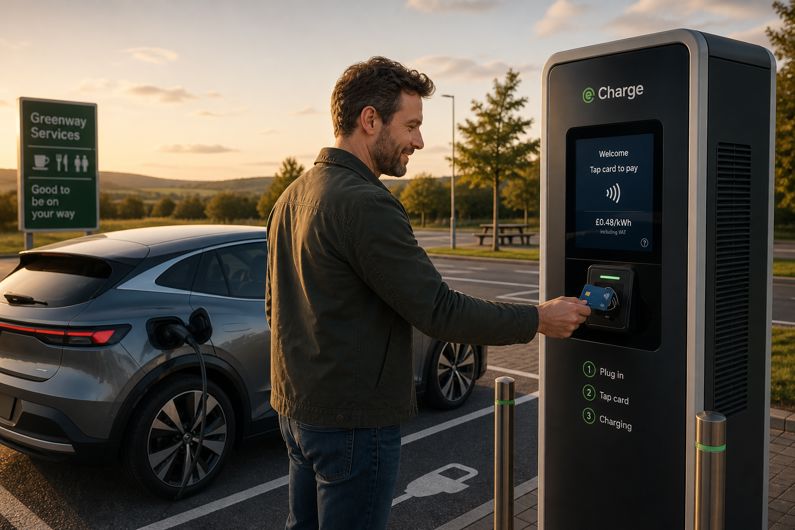
Public EV Chargers Should Work Without an App
A driver reaches a public charger with a low battery, finds an available connector, and discovers that the next step is downloading an app. Then comes an account, an email verification, a payment method, and perhaps a prepaid wallet. None of this puts electricity into the car.
That is a poor bargain for someone buying a basic roadside service. Using public EV charging should not require becoming a member of a software platform. Apps can improve the experience, but they should not be the admission ticket.
The problem is the compulsory account
Charging apps have legitimate uses. Regular customers may want discounted tariffs, charging history, or notifications when their battery reaches a chosen level. Fleet operators need billing tools. Those are reasons to offer an account, not reasons to make every passing driver create one.
The compulsory app also introduces dependencies that have little to do with the charger itself. A driver needs a compatible phone, enough battery, mobile network coverage, and access to whichever verification method the operator uses. A visitor from another country may face app-store restrictions or payment problems. A working charger can become practically unusable without suffering an electrical fault.
Contactless card payments remove several of those steps. They do not eliminate every dependency: payment terminals also need maintenance and communications. But they avoid making the customer's phone another essential component of the charging station.
Make the ordinary transaction ordinary
A reasonable minimum experience would look like this:
- Show the price before payment. Display the energy rate, any session fee, and the conditions for time-based or idle charges.
- Offer a clearly marked guest-payment route. A driver should not have to hunt through membership offers to find it.
- Explain payment holds. If a temporary authorisation exceeds the eventual bill, say so before the driver approves it.
- Provide charging session receipts without mandatory registration. Customers need a usable record of the energy delivered and the charges applied.
- Make help reachable. Put a station identifier and support number where they remain visible when the screen fails.
Charging station accessibility belongs in that minimum too. A payment screen is not genuinely convenient if its position, contrast, or instructions exclude drivers who could otherwise use the charger.
This is not merely a hypothetical policy preference. The EU's Alternative Fuels Infrastructure Regulation establishes requirements for ad hoc charging and payment at publicly accessible charging points, with details varying by installation date and power output. The useful principle is that buying a charge should be possible without a continuing contractual relationship with the operator.
EV roaming services can help drivers use multiple networks through one account. They are valuable, but consolidating five memberships into one is still different from allowing a straightforward guest transaction.
Operators should also make charger reliability reporting reflect the whole transaction. A charger that answers a remote status check but repeatedly fails at payment is not delivering a reliable service.
The test is simple: can a first-time visitor arrive, understand the price, pay, and start charging? If not, the operator has built a customer-registration process with a charger attached.

Working as Lead Data Scientist with ICL Services in Kazan. I have 11 years of experience in data analysis and machine learning, and earlier worked with BARS Group as Data Analyst. I graduated from Kazan Federal University with a bachelor's degree in Applied Mathematics and Physics and completed a master's degree in Data Science at Innopolis University. In my free time I like playing ice hockey and cooking.