A Car’s Basic Controls Should Not Need a Menu
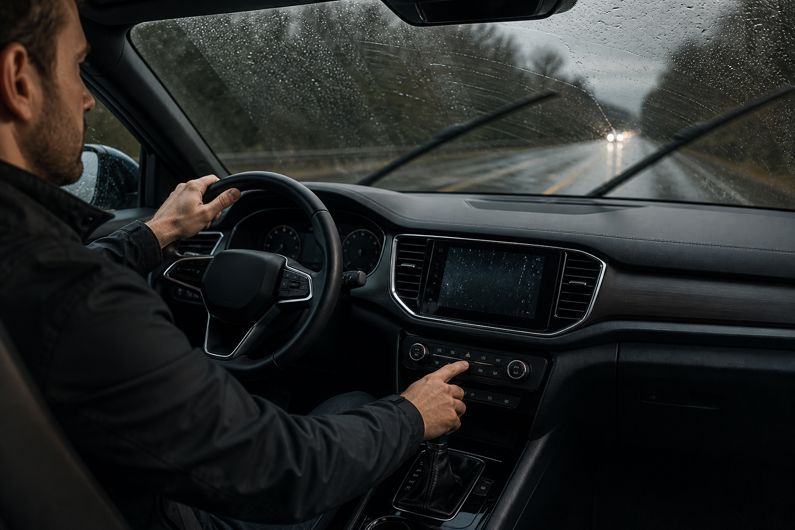
A touchscreen is a reasonable place to choose a podcast. It is a much less reasonable place to hunt for the windscreen demister while driving through heavy rain. Car manufacturers sometimes treat both tasks as interface-design problems of equal importance. They are not.
My view is straightforward: controls a driver may need urgently should be easy to locate and operate without searching a screen. That does not mean removing displays. It means recognising that a moving car is not a smartphone with seats.
The real issue is attention, not nostalgia
The case for physical controls in cars is not that older dashboards were automatically better. Some were crowded, confusing and poorly labelled. But a well-positioned dial offers something a flat display cannot fully reproduce: a fixed location and a shape your fingers can recognise.
Consider touchscreen climate controls. Adjusting the temperature might involve opening a panel, finding a small target and checking whether the tap registered. A dedicated knob can make the same task more direct. Neither design eliminates distraction, but the number of steps—and the need to look—matter.
The US National Highway Traffic Safety Administration includes adjusting entertainment and navigation systems among activities that can divert attention from driving. That is useful context for driver distraction research: the relevant question is not whether an interface looks modern, but what it asks the driver to do while the vehicle is moving.
Keep essential functions predictable
A sensible dashboard does not need a separate button for every setting. It needs priorities:
- Immediate visibility and signalling: demisting, wipers and hazard lights should have clearly identifiable, readily accessible controls.
- Frequent adjustments: temperature and audio volume deserve simple operation rather than repeated trips through menus.
- Occasional configuration: ambient lighting, account settings and detailed preferences can live on a screen, with demanding tasks reserved for when the vehicle is parked.
Voice control in cars can help, particularly when it works reliably. But it should be an alternative, not the only practical escape from a complicated menu. Cabin noise, recognition errors and differences in speech can turn a simple request into a conversation the driver never wanted.
There is also a software issue. As software-defined vehicles become more common, manufacturers can change interfaces after purchase. Over-the-air software updates can fix mistakes, but moving a familiar control or adding a menu layer can undermine habits built over months. For essential functions, consistency is a safety consideration, not merely a design preference.
Good automotive interface design should be judged from the driver’s seat, under realistic demands—not just in a showroom demonstration. Can someone find the demister quickly? Can they adjust the temperature without studying the display? Does the interface remain usable when voice recognition fails?
A large screen can be useful. Making it responsible for almost everything is a choice, not an inevitable form of progress.

Hello, My self is Jahnavi and I am a software developer at Wipro company I have completed my BCA from AKTU Lucknow and MCA from LPU Punjab. After that, I took many internships and one training in C# course from MindStick Training Platform. I thank the team of MindStick Platform who helped me in the transformation of my journey. In my personal life, I love to explore nature and food stuff.