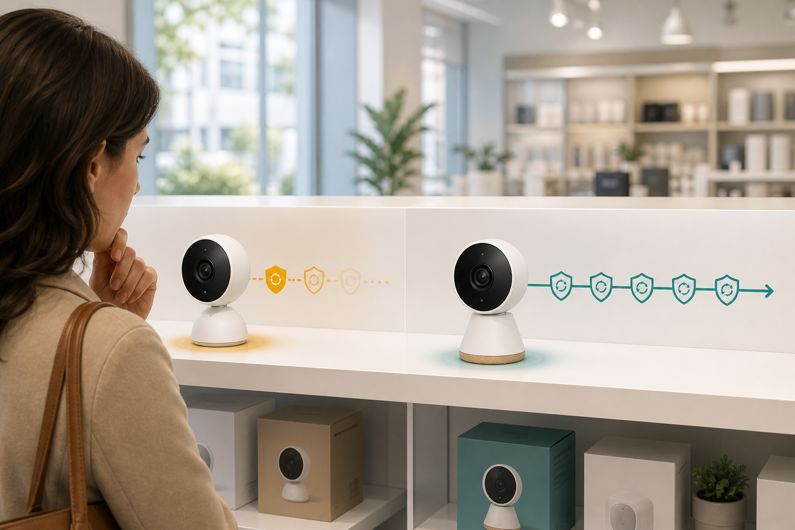
A Smart Device Should Show Its Support Expiry Date Before You Buy It
A connected security camera can keep producing sharp video long after its manufacturer stops fixing security flaws. From the owner’s perspective, nothing has broken. That is precisely the problem: the useful life of the hardware and the safe, supported life of the software are not necessarily the same.
We compare resolution, battery capacity and discounts before buying gadgets. I would like to see another specification displayed just as prominently: the date until which the manufacturer commits to providing security updates. Not buried in a help page. Beside the price.
The discount can hide a shorter supported life
Imagine two connected cameras with similar features. One costs ₹3,000 and has one year of promised security support remaining. Another costs ₹4,500 and has four years remaining. The cheaper camera is not automatically the better purchase, even if both are brand new and arrive in sealed boxes.
This matters because a support commitment may run from a product’s launch or another specified date, rather than from your purchase. A device sitting in a warehouse can consume part of that window before anyone switches it on. Clearance sales should make the remaining support period more visible, not less.
Dividing the purchase price by the years of guaranteed support is not a complete measure of value. Hardware can fail, subscriptions can rise, and a vendor may provide updates beyond its promise. But it is a useful comparison that most shopping pages do not make easy.
A promise needs more than a date
There is already a practical precedent. Under the UK’s consumer connectable product security regime, which took effect on 29 April 2024, manufacturers of covered products must publish their defined security update support period. The security requirements in Schedule 1 of the regulations require that information to be clear, accessible and transparent. This is a disclosure requirement, not a universal guarantee of a particular number of support years.
That distinction matters. A prominently disclosed short commitment remains a short commitment. Still, making the promise visible gives buyers something concrete to compare and retailers something concrete to display.
I would also want manufacturers to answer three questions:
- What gets updated? Device firmware, the companion app and the cloud service are different parts of the product. A vague promise of “ongoing support” does not explain the scope of security updates.
- What survives a shutdown? The end of security patches is different from a cloud service shutdown. Buyers should know whether local controls, recordings or basic functions will still work.
- How will owners hear about it? An end-of-support notification should arrive before support ends, with practical options—not merely appear on a webpage owners have no reason to revisit.
None of this means an unsupported device becomes compromised at midnight on its expiry date. Risk depends on its exposure, vulnerabilities and use. But buyers should not have to discover a manufacturer’s limits after installing cameras around their home.
For connected home devices, a long feature list is only half the sales pitch. The other half is how long the company is prepared to stand behind the software. That belongs on the shelf label.

Staff Software Engineer at Adobe with 10 years of experience in backend services and distributed systems. Before that I was a Software Engineer at Apple. B.S. in Computer Science, Stanford University. Based in San Jose, California. In my spare time you will find me reading.