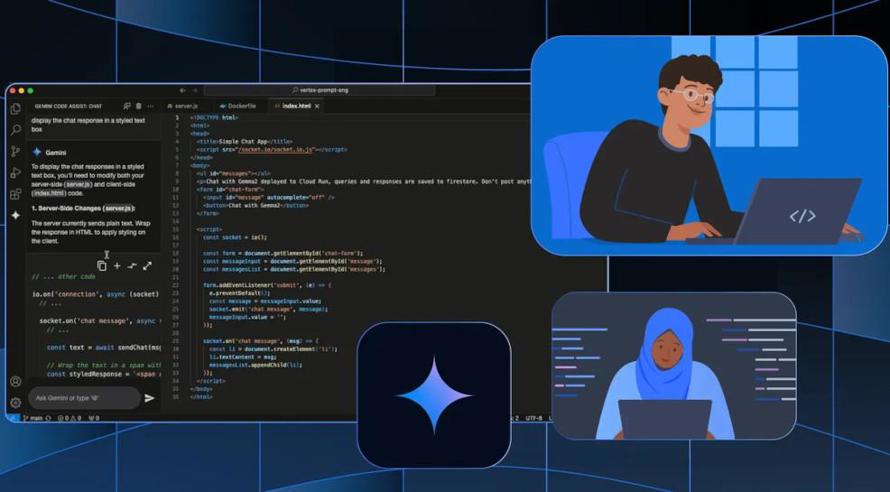
Google Launches Gemini 4 Argon for Coding and Complex AI Tasks
Google has launched Gemini 4 Argon, a new model positioned for coding work and other complex AI tasks. The announcement puts software development alongside broader reasoning-heavy work as a central use case for the Gemini model family.
That positioning speaks to a growing expectation of AI assistants: they should be useful not only for quick answers, but also for work that involves several connected steps. In software development, that might mean understanding an existing codebase, helping trace a bug, or drafting and revising a feature. For other demanding tasks, the challenge can be similar—keeping track of context and producing an answer that is useful beyond a single prompt.
Why the coding focus matters
Coding is a demanding test for AI systems because a response can look plausible and still be wrong. A useful model needs to follow the task, respect the surrounding code, and help developers check whether a proposed change actually works. The announcement’s emphasis on coding therefore raises practical questions about how Gemini 4 Argon performs in real development workflows, not just how fluent its answers sound.
For developers, the relevant measures will include accuracy, consistency, and how much human review the model’s suggestions require. It also matters whether the model can help with the unglamorous parts of programming—understanding unfamiliar code, narrowing down an error, and making a change without breaking something nearby.
What to look for next
The launch itself establishes the intended focus, but day-to-day usefulness depends on details such as where the model can be accessed, what tools it supports, and how it handles longer tasks. Availability, pricing, and any published performance evaluations will help developers decide whether it belongs in their existing workflow. Those details should be checked against Google’s current product information rather than assumed from the model’s name or positioning.
Teams considering a new AI model can start with a small, representative set of tasks: a bug report drawn from their own work, a code change with clear acceptance criteria, or a question about a module that developers often find difficult to understand. Comparing the results with existing tools can reveal whether Gemini 4 Argon saves time and where human checks remain essential.
For now, the key news is Google’s decision to present Gemini 4 Argon as a model for both coding and complex AI tasks. Its practical impact will become clearer as access and evaluation details emerge and developers try it against the problems they actually need to solve.

The information provided here is part of Export Import Training online After the exploration of information technology, the world is on our finger tips to get any piece of information. However when I went through different subjects on the web, I realized, like every thing in society, internet also carries the good and the bad. I was surprised to note that, I could not find any good quality free tutorial program to enter in a good business especially in