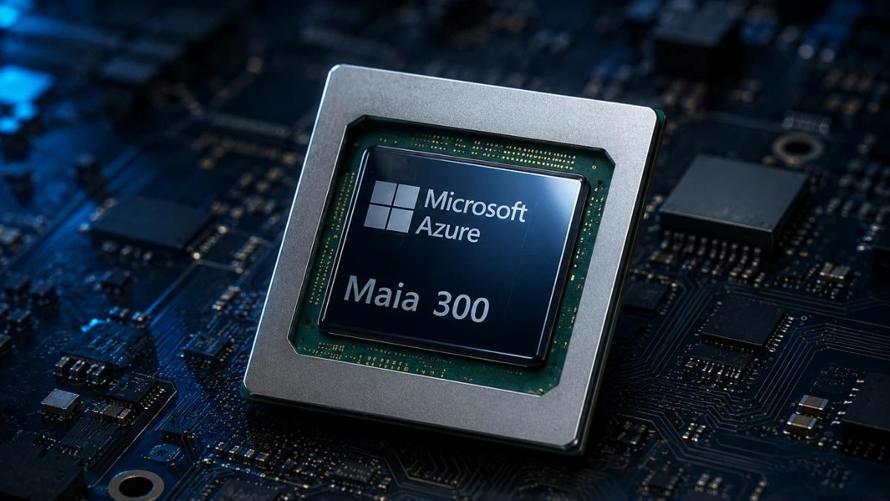
Microsoft Expands Maia AI Chips in Push to Lower Inference Costs
Microsoft’s expansion of its Maia AI chips is aimed at a costly part of the AI business: running models after they have been trained. That work, called inference, happens every time a service answers a prompt, summarizes a document, or generates code. At large scale, the cost of serving those requests can matter as much as the cost of building the model in the first place.
The announcement points to a broader effort to shape the economics of AI services, not simply add another processor to Microsoft’s catalog. A chip designed around AI inference workloads may be better matched to the repeated calculations those services perform. If it can handle those tasks efficiently, Microsoft has a chance to reduce the cost per generated token and make it easier to offer AI features across more products and customers.
Why custom chips matter for inference
General-purpose GPUs have powered much of the recent AI boom, but demand for them is high and they are not the only possible answer to every workload. Companies building their own custom silicon can tune hardware, software, and the way jobs are scheduled around particular needs. That does not guarantee lower costs: the chips still have to perform well, be available in useful quantities, and work reliably with the models and services customers depend on.
For Microsoft, the potential advantage comes from coordinating the chip with its cloud platform. A purpose-built processor is most useful when the surrounding systems can make good use of it, from model execution and memory management to the software tools developers use. The relevant measure is therefore not a chip’s headline performance alone, but what it costs to serve a real request at the quality and speed customers expect.
The economics are in the deployment
Expanding Maia matters only if the hardware reaches production services at meaningful scale. Running a chip in Azure data centers involves more than installing it: Microsoft must integrate it into its infrastructure, support the workloads customers run, and keep performance predictable when demand changes. Those operational details can determine whether a promising processor changes cloud costs or remains a specialized option.
There is also a supply question. In-house chips could give Microsoft another source of capacity and help ease exposure to GPU supply constraints, but they do not make the broader infrastructure challenge disappear. AI services still need power, networking, storage, and facilities capable of handling dense computing equipment. A savings on one component can be diluted if another part of the system becomes the bottleneck.
What to watch next
The most useful signals will be practical ones: which services use Maia, how broadly it is available, and whether Microsoft shares comparable information about performance or operating costs. Customers will also want to know how easy it is to run existing workloads on the new hardware. A strong hardware and software stack can make a difference, but migration effort and compatibility matter just as much to teams choosing a cloud platform.
For now, the expansion is best read as a bet on improving inference economics through tighter control of the infrastructure. It could give Microsoft more flexibility as AI usage grows, while reducing reliance on a single class of accelerator. Whether that translates into lower prices for customers—or primarily improves Microsoft’s own margins—will depend on deployment scale, utilization, and how the savings are passed through to the services people actually use.

I am a Senior Consultant Gynaecologist at Kamla Nehru Memorial Hospital, Prayagraj, with 16 years of clinical experience. I completed my MBBS from Moti Lal Nehru Medical College, Prayagraj and MS in Obstetrics and Gynaecology from Moti Lal Nehru Medical College, Prayagraj. My areas of interest are high risk pregnancy, normal delivery and PCOS management. I believe in explaining every diagnosis to my patients in simple language.