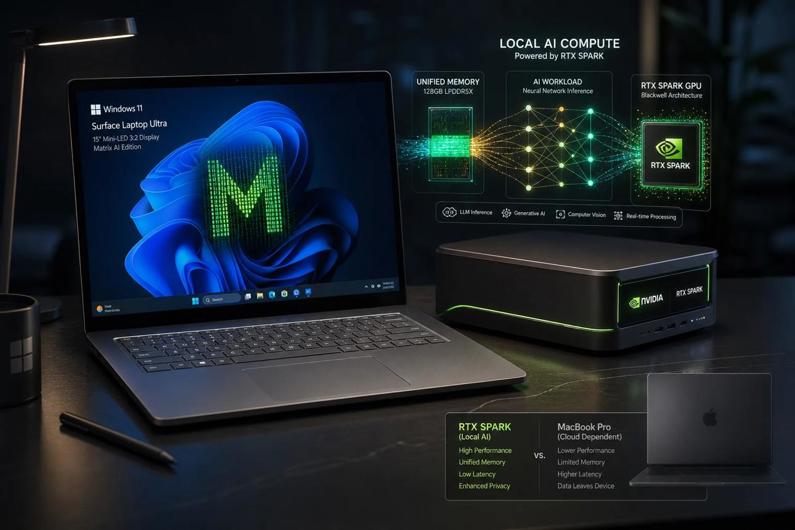
Microsoft and Nvidia Put Local AI Inference Within Reach on Windows PCs
Running an AI model on your own PC used to mean accepting a fairly technical setup—or settling for a small demo. Microsoft and Nvidia are working to make local AI inference on Windows a more practical option, pairing Windows’ growing AI developer tools with Nvidia’s RTX GPU software.
The distinction matters. Inference is the work of running a trained model to answer a prompt, summarize a document, or generate an image. When it happens on a PC rather than in a remote data center, a capable machine can respond without sending every request to a cloud service. That can help with responsiveness, privacy, offline access, and recurring usage costs, though the trade-offs depend on the model and the hardware.
Two pieces of the same problem
Microsoft’s Windows AI tools are intended to give developers a more consistent way to discover and run models on Windows. Nvidia brings a different part of the stack: its CUDA ecosystem and RTX-focused inference software can use the GPU’s parallel processing capabilities to accelerate supported workloads. Together, those layers can make it easier for an application to use the hardware already inside an RTX-equipped PC instead of treating local inference as a one-off experiment.
That does not mean every Windows computer suddenly becomes a fast AI workstation. GPU memory, model size, quantization, software compatibility, and the particular task all affect performance. A compact language model may run comfortably on a consumer GPU; a much larger model can still require more memory than the system has available. The RTX GPU acceleration is useful, but it is not a substitute for adequate hardware or well-optimized software.
Why the software layer matters
Hardware announcements get attention, but developers also need dependable runtimes and a manageable way to package models. Windows AI Foundry is part of Microsoft’s effort to provide that application-facing layer. On Nvidia hardware, tools such as the TensorRT-RTX inference engine are designed to optimize inference for RTX GPUs. The practical goal is to reduce the amount of platform-specific work needed to turn a model into a feature people can use inside a Windows application.
For users, the interesting outcome is not simply that a model can run locally. It is whether an app can make that capability useful: drafting from files stored on the PC, transcribing audio without a round trip to a server, or offering an assistant that still works when the connection is poor. Those are examples of on-device language models and other local AI workloads becoming part of ordinary desktop software, rather than a separate developer project.
Local AI will complement the cloud, not replace it
Cloud models will remain attractive for demanding tasks, large context windows, and services that need to be updated centrally. Local models have their own limits, but they can handle some everyday work with less dependence on network access. Applications may increasingly choose between local and cloud-based AI services based on the task, the user’s settings, and the PC’s capabilities.
The real test for Microsoft and Nvidia is whether these tools lead to applications that install easily, use the right GPU without fuss, and explain clearly when data stays on the device. Better inference infrastructure is a meaningful step. For Windows users, though, the payoff will be measured in useful features—not in how many runtimes or model names appear in a developer announcement.

An enthusiastic, adaptive, and fast-learning person with a broad and acute interest in the discovery of new innovative drugs, I particularly enjoy collaborating with scientists from different disciplines to develop new skills and solve new challenges.