TakeMe2Space’s Orbital Data Center Network: What It Means for the Future of Cloud Infrastructure
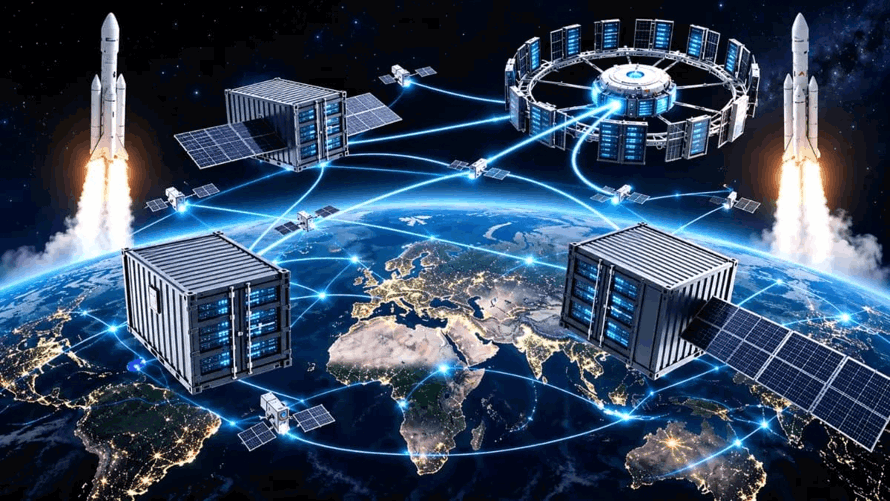
There is something quietly audacious about a Bangalore-based startup deciding that the next frontier for data storage and computation is not another hyperscale warehouse on the outskirts of a desert city, but rather a constellation of satellites circling the Earth. TakeMe2Space, an Indian space-tech venture, has been quietly laying the groundwork for what it calls an orbital data center network. If this pans out, it could shift how we think about latency, redundancy, and the physical boundaries of the cloud.
The Premise Behind the Orbit
Most of us interact with the cloud as an abstraction. We upload a photo, stream a video, or spin up a virtual machine, and somewhere in a region we have never visited, silicon hums away processing our requests. The industry has spent two decades chasing lower latency by placing edge nodes closer to end users. TakeMe2Space is proposing a different vector entirely: instead of pushing compute to the edge of a city, push it to the edge of the atmosphere.
Their pitch centers on three operational promises. First, reduced round-trip latency for inter-continental traffic by bypassing terrestrial fiber backbones. Second, geographic redundancy that is genuinely global—no single jurisdiction, natural disaster, or grid failure can take down an entire node. Third, the ability to serve remote or underserved regions that lack robust terrestrial infrastructure. These are not merely marketing bullet points; they address genuine pain points in enterprise disaster recovery and content delivery.
Technical Architecture and Orbital Mechanics
What makes this concept distinct from a simple satellite-linked server farm is the integration of orbital mechanics with cloud-native design. The proposed architecture relies on a fleet of small satellites in low Earth orbit, each carrying hardened compute modules, solid-state storage arrays, and inter-satellite laser links. Rather than routing everything through a ground station, the satellites would form a mesh network, allowing data to hop between nodes before ever touching Earth.
This introduces a fascinating set of engineering constraints. Thermal management in vacuum is radically different from a chilled data center aisle. Radiation hardening becomes non-negotiable; a single-event upset could corrupt memory or flip bits in persistent storage. Power, too, is a puzzle. While solar arrays can sustain operations, peak compute loads may require onboard batteries or even beamed power concepts that are still largely experimental.
Latency Realities vs. Marketing Hype
It is worth tempering expectations with some physics. A signal traveling from a user in Mumbai to a satellite at 550 kilometers altitude and back incurs a minimum round-trip time of roughly 7 milliseconds just for the radio propagation. Add processing, queuing, and any terrestrial handoff, and you are looking at latency comparable to, or slightly worse than, a well-placed edge node in a major metro. The real advantage emerges on trans-oceanic routes. A packet traveling from New York to Singapore via a terrestrial path crosses multiple undersea cables and routing hops; an orbital path could theoretically offer a more direct geometric route, though this depends heavily on orbital inclination and ground station placement.
Regulatory and Spectrum Hurdles
Space is not an unregulated commons, despite what popular imagination might suggest. Any orbital network must secure spectrum allocations for inter-satellite links and ground-to-space downlinks. In India, this falls under the purview of the Department of Space and the Telecom Regulatory Authority of India, while international coordination with the ITU is required to prevent interference with existing services. TakeMe2Space will also need launch partnerships—likely with ISRO’s commercial arm or private providers like Skyroot Aerospace—and compliance with debris mitigation guidelines. The Kessler syndrome risk, while minimal for a small constellation, is a conversation that regulators increasingly expect startups to address in their filings.
Economic Viability and Target Markets
Building and launching even a modest constellation is expensive. Estimates for a proof-of-concept orbital data node run into the tens of millions of dollars when factoring launch, satellite fabrication, and ground infrastructure. TakeMe2Space’s path to viability probably hinges on niche markets first: financial institutions needing millisecond-grade synchronization across continents, defense and intelligence agencies requiring resilient communications, or scientific collaborations processing petabytes of observational data directly in orbit.
For mainstream consumer cloud services, the economics remain challenging. Terrestrial data centers benefit from decades of supply chain optimization, cheap renewable power in specific regions, and mature cooling technologies. An orbital alternative must demonstrate a compelling total cost of ownership, not just a technical novelty. That said, as launch costs continue their downward trend—partly driven by reusable first stages and indigenous small-lift capabilities—the barrier to entry is slowly eroding.
What to Watch in the Coming Years
TakeMe2Space is still in the early stages. Public disclosures are limited, and much of the technical detail remains under wraps. What we can watch for includes:
- Launch milestones: Confirmation of satellite deployment timelines and orbital parameters.
- Partnership announcements: Ground station agreements with international telecom operators or cloud providers.
- Regulatory filings: Spectrum requests and debris mitigation plans submitted to national and international bodies.
- Proof-of-concept demonstrations: Even a small-scale test of inter-satellite data relay would validate core assumptions.
Until then, the idea remains speculative but grounded in real engineering possibilities. It is a reminder that the cloud is still physically located somewhere, and that somewhere could eventually be above us.

Anubhav Sharma is a passionate content writer who loves turning everyday ideas into engaging stories. Writes about technology, business, lifestyle, and current trends in a simple and relatable style. With a curious mind and a love for words, Anna enjoys creating content that informs, inspires, and connects with readers.