
How ISO Certification Opens Global Opportunities in Philippines

From the Philippines to the World: How ISO Certification Opens Global Opportunities
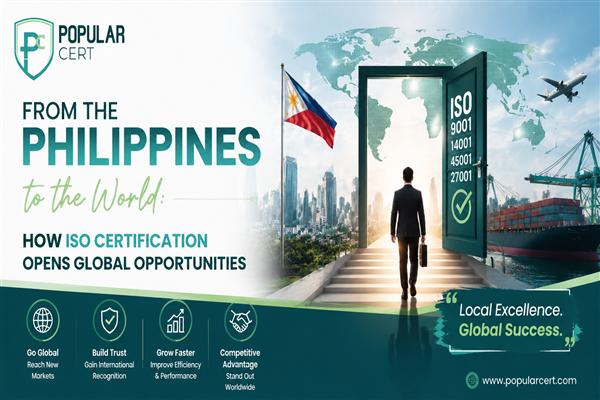
The Philippines is home to skilled professionals, ambitious entrepreneurs, growing exporters, and manufacturers with the potential to compete far beyond local markets. Today, many Filipino businesses are no longer satisfied with serving customers at home. They are looking for international clients, overseas partnerships, export opportunities, and long-term growth.
But entering global markets requires more than a good product or competitive pricing. International buyers want confidence. They need to know that a company can consistently deliver quality, manage risks, protect information, and follow reliable business processes.
For many Philippine businesses, ISO Certification in the Philippines provides that important proof of credibility. It demonstrates that an organization follows internationally recognized management practices and has undergone an independent assessment of its systems. More importantly, the process can strengthen the business from within and prepare it for sustainable international growth.
What Does ISO Certification Actually Mean?
ISO refers to the International Organization for Standardization, a global organization that develops standards designed to help businesses operate safely, efficiently, and consistently.
These standards cover many areas of business, including quality management, environmental performance, occupational health and safety, food safety, and information security.
When an organization achieves an ISO certificate, it demonstrates that its management system has been assessed against the requirements of a recognized international standard. It provides customers and business partners with something stronger than a simple promise of quality—a documented and independently assessed system.
ISO certification is also much more than receiving a certificate. Organizations must establish appropriate processes, train employees, manage risks, maintain records, monitor performance, and continually improve their systems. As a result, certification can represent a meaningful improvement in the way a business operates.
For a Filipino company seeking overseas customers, this internationally recognized evidence can make a significant difference when building credibility with buyers who may never visit the company's offices or facilities.
Why International Buyers Value ISO Certification
Imagine being a procurement manager in Europe, Japan, or the United States searching for an overseas supplier. You may be evaluating businesses from several countries, but you cannot personally inspect every factory, office, or production process.
This is where internationally recognized standards become valuable.
ISO certification can provide buyers with confidence that:
- Business processes are documented and consistently followed.
- Quality is monitored throughout operations rather than checked only at the end.
- Risks are identified and managed systematically.
- Employees understand their responsibilities and processes.
- The organization is subject to regular assessment and continual improvement.
In sectors such as manufacturing, construction, food production, logistics, and information technology, ISO certification may also be requested by customers, procurement teams, or tendering organizations.
For Philippine businesses, this means certification can be more than a competitive advantage. In certain markets and contracts, it can help a company meet an important supplier qualification requirement and gain access to opportunities that might otherwise remain unavailable.
Combining Filipino Strengths With Global Standards
Filipino professionals have developed a strong international reputation for their skills, adaptability, communication abilities, and work ethic. These qualities have helped Philippine businesses establish themselves in industries ranging from BPO and IT services to manufacturing and exporting.
ISO Certification in the Philippines can strengthen these existing advantages by placing them within a structured and internationally recognized management framework.
Instead of simply telling an overseas customer that your company values quality and reliability, certification provides evidence that these principles are supported by documented processes, defined responsibilities, monitoring systems, and continual improvement.
This combination of local business strengths and globally recognized standards can help Philippine companies compete more confidently in international markets.
ISO Standards Commonly Pursued by Philippine Businesses
Different organizations require different management systems depending on their industry, customers, and growth objectives.
ISO 9001 – Quality Management System:
One of the world's most widely adopted ISO standards, ISO 9001 focuses on consistent quality, customer satisfaction, process control, and continual improvement. It is suitable for businesses across almost every industry.
ISO 14001 – Environmental Management System:
This standard helps organizations manage their environmental responsibilities systematically. It can be particularly valuable for companies working with international customers that have strong sustainability and environmental expectations.
ISO 45001 – Occupational Health and Safety Management System:
ISO 45001 focuses on workplace health and safety. It can demonstrate that an organization takes employee welfare, hazard identification, and workplace risk management seriously.
ISO 22000 – Food Safety Management System:
Food manufacturers, processors, exporters, and other organizations involved in the food supply chain can use ISO 22000 to establish structured food safety controls and strengthen buyer confidence.
ISO 27001 – Information Security Management System:
For IT companies, BPO providers, financial organizations, and businesses handling sensitive information, ISO 27001 demonstrates a systematic approach to protecting data and managing information security risks.
The appropriate standard—or combination of standards—depends on the organization's activities, customer expectations, target markets, and business objectives.
The Benefits Go Beyond International Recognition
Although global credibility is an important reason to pursue certification, the internal benefits can be equally valuable.
Better Operational Efficiency
Preparing for certification encourages businesses to clearly document workflows and responsibilities. This can reveal duplicated tasks, inefficient processes, and unnecessary delays that may have previously gone unnoticed.
More Effective Decision-Making
ISO management systems emphasize monitoring, measurement, internal audits, and evidence-based decisions. Over time, this can help management make more informed choices.
Increased Customer Confidence
ISO certification can strengthen trust among international customers as well as domestic clients. It demonstrates that the organization follows a structured approach to managing quality and business processes.
Reduced Business Risk
A well-implemented management system helps organizations identify potential risks before they become serious problems. Depending on the standard, these risks may involve quality, workplace safety, environmental performance, or information security.
Greater Employee Engagement
Clearly defined processes and responsibilities help employees understand what is expected from them. This can create a more organized working environment and support consistent performance.
Ultimately, ISO certification is not simply about displaying a certificate. It can help create a stronger, more organized, and more resilient business.
Why Choosing the Right Certification Partner Matters
The certification journey can become challenging when businesses have limited internal resources or are unfamiliar with ISO requirements. Poor planning can lead to confusing documentation, unnecessary delays, and difficulty preparing employees for the certification audit.
This is where PopularCert supports Philippine businesses.
PopularCert works with organizations ranging from growing SMEs to established exporters and provides guidance throughout the certification process. Its approach focuses on understanding the organization's actual operations instead of relying solely on generic templates.
Businesses can receive support with gap assessment, documentation, employee training, internal audits, implementation, and preparation for the external certification audit. The process is designed to provide clear direction at each stage so business owners understand what needs to be completed and why.
PopularCert also considers the organization's industry and business objectives when recommending standards. This allows companies to pursue certification that supports their actual growth plans rather than investing in a management system that does not match their needs.
What the ISO Certification Journey Looks Like
For businesses starting their ISO journey, the process generally follows several key stages:
1. Initial Assessment: The organization's current practices are reviewed to identify gaps against the selected ISO standard.
2. Planning and Documentation: Policies, procedures, records, and controls are developed or improved based on actual business activities.
3. Implementation and Training: Employees are introduced to the management system and trained on their responsibilities.
4. Internal Audit: The organization reviews its system internally to identify and correct issues before the external assessment.
5. Certification Audit: An external certification body assesses whether the organization meets the applicable requirements.
6. Ongoing Improvement: After certification, the management system must continue to be maintained, monitored, and improved through surveillance audits and ongoing corrective actions.
With the right preparation and professional guidance, this process becomes much easier to manage.
Take Your Philippine Business to the Global Market
Philippine businesses already possess many of the qualities needed to compete internationally—talent, adaptability, experience, and entrepreneurial ambition. What they increasingly need is credible evidence that their systems meet international expectations.
ISO Certification in the Philippines can provide that evidence while simultaneously strengthening internal operations, improving customer confidence, reducing risks, and creating a stronger foundation for sustainable growth.
For businesses planning to enter international markets, secure overseas contracts, or strengthen their reputation with global customers, ISO certification can be an important step forward.
With the support of an experienced partner such as PopularCert, Filipino businesses can approach the certification process with greater clarity and confidence—from the initial assessment through implementation, audit preparation, certification, and continual improvement.
At Popularcert, we simplify the path to global compliance. We offer end-to-end consulting, training, and auditing services for organizations seeking ISO, CE Mark, HACCP, GMP, BIFMA, and various other product and compliance certifications. We don’t just provide a service; we build partnerships with industry leaders worldwide by focusing on: